

 Back
Back
Luciano Fabro
Artists
Luciano Fabro
Press release
Curated by Fiammetta Griccioli, Roberta Tenconi and Vicente Todolí
A central figure in postwar Italian art, Luciano Fabro (Turin, 1936 – Milan, 2007) was a prominent exponent of the Arte Povera movement. From the very beginning of his career, he developed a personal investigation into the concept of inhabiting space—conceived as a dynamic field of action—while simultaneously exploring the gaze, experience, andrelationship of the viewer with the work and the surrounding environment.
His research delved into the linguistic aspects of sculpture, which he approached not merely as a form but as a necessity tool for reading and interpreting the structures of lived experience.
Throughout his career, Fabro experimented with the expressive potential of various materials, ranging from traditional ones such as marble and iron to less conventional like glass and silk, each chosen for its specific sensory and symbolic qualities.
Alongside his artistic production, Fabro also developed a rigorous theoretical approach, making significant contributions to art theory, grounded in meticulous conceptual reflection. This intellectual foundation underpinned the creation of complex, imaginative, and layered works that propose innovative spatial configurations and challenge conventional understandings of form.
The exhibition by Luciano Fabro at Pirelli HangarBicocca
The first retrospective in a museum dedicated to Luciano Fabro in Italy since the artist’s passing in 2007, the exhibition at Pirelli HangarBicocca will present a wide selection of sculptures and installations among the most significant of his research. Organized in collaboration with the Archivio Luciano e Carla Fabro, the survey explores the artist’s conceptual and aesthetic approach to space, investigating how it interacts with the perception of those who inhabit it.
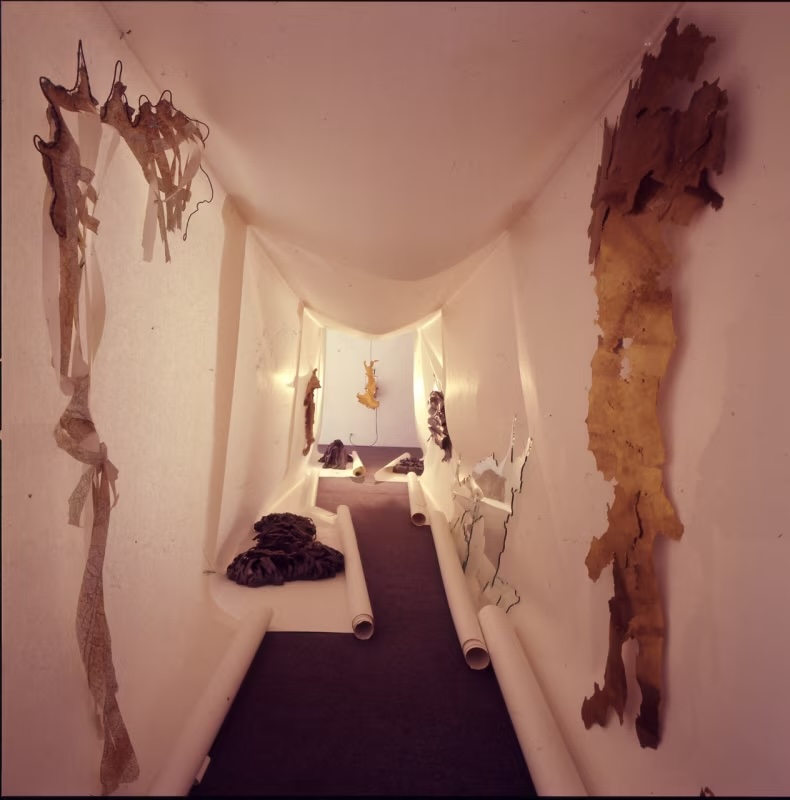
Particular emphasis will be given on the perceptual and spatial investigations initiated by Fabro in the 1960s, tracing its evolution through seminal works such as In cubo (1966) and his experiments with mirrored surfaces, and culminating in more complex architectural structures and spaces—often made of paper—that the artist referred to as “Habitats”: ideal environments, either autonomous or integrated into existing spaces, conceived to host and activate works.
This retrospective also offers an opportunity to reflect on Fabro’s deep connection with the city of Milan, where he moved in 1959 and where, from 1983 to 2002, he taught at the Brera Fine Arts Academy, becoming a central figure in the city’s cultural life and an influential mentor to generations of younger artists.
- From
- 08 October 2026
- Venue
- Pirelli Hangar Bicocca
- Address
- Via Chiese, 2
20126 Milano
- Hours
- Thu-Sun:10:30-20:30