

 Back
Back
Afterimage (Composites)
Artists
Jojo Gronostay
Press release
Ich hoffe, daß wir siegen. Ich bin sogar fest von unserem Sieg überzeugt. Die Vernunft muß siegen!
Die letzten Zeilen. In: Jewgenij Samjatin. Wir. Roman. Dt. v. G. Drohla. Wien, Büchergilde Gutenberg, o. J.
An Afterimage is an optical illusion that occurs when a visual stimulus leaves an imprint on the retina that persists even after the stimulus itself has disappeared. Often appearing as flashes of colour, it marks a moment of superimposition between past and present, between what still exists and what is disappearing. In Jojo Gronostay’s practice, this “in-betweenness” and layering are reflected in the materials and images bearing traces of political and economic structures, which shape relationships between formerly colonised African countries and the so-called West.
The new series Untitled (Afterimage) (2026) brings together two-colour fields – a tactile, fabric-like brown and an acidic yellow a.o. – joined by a strip of logo-printed adhesive tape that binds them under Gronostay’s label, Dead White Men’s Clothes (DWMC). The name draws on the Ghanaian term “Obroni Wawu,” an expression that emerged during the first wave of second-hand clothing shipments from Europe to Ghana: the garments were of such high quality that locals could scarcely believe they were being given away, assuming their previous owners must have died.
For the project, Gronostay travelled to Ghana repeatedly, selected garments at Kantamanto Market in Accra – one of the world’s largest second-hand textile markets – and brought them back to be reintroduced into a Western context, making visible the global circulation of goods and the creation of worth and value.
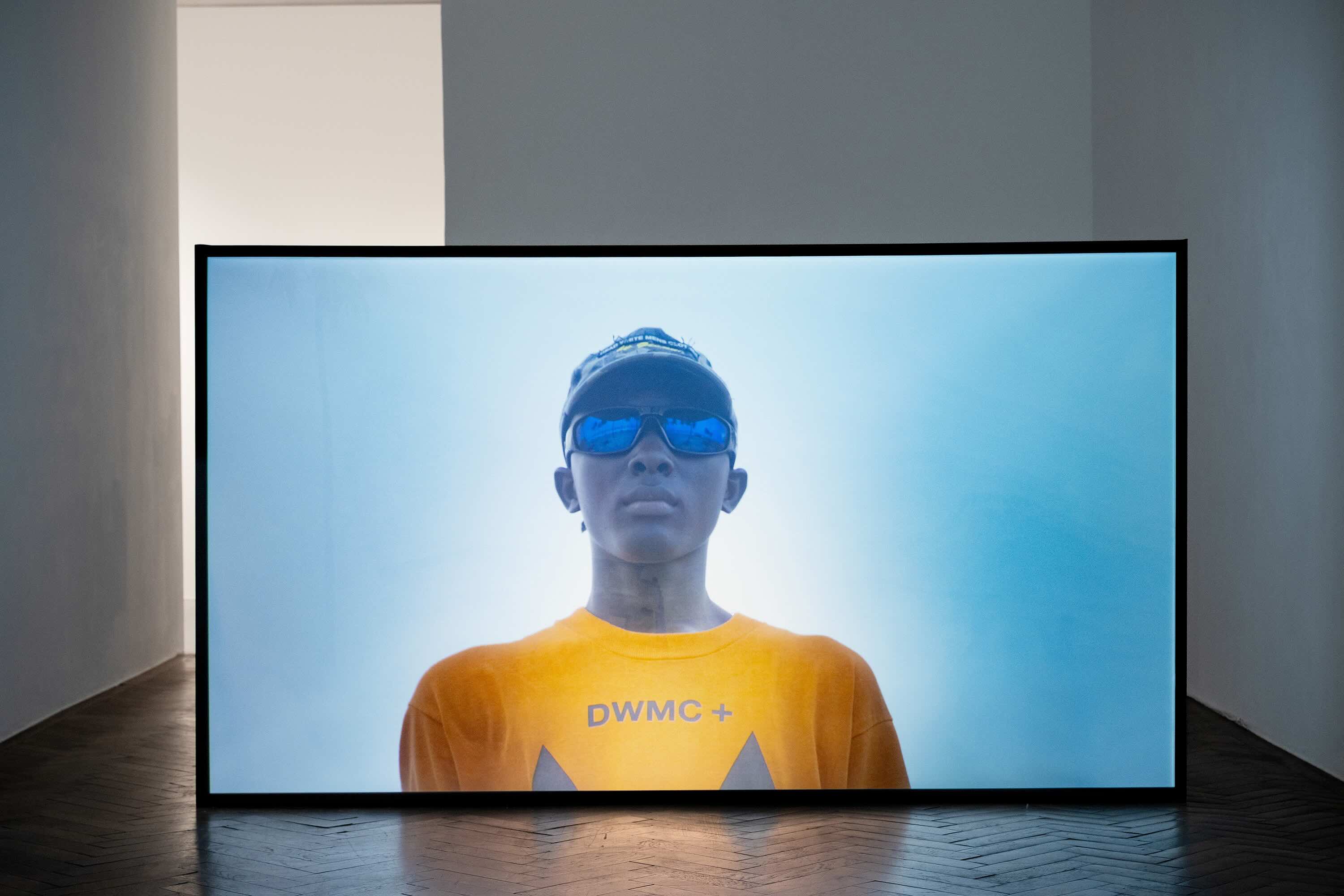
In the central work of Jojo Gronostay’s second solo show at the gallery, the video The Elephants (2025), the DWMC label reappears on caps and T-shirts, alongside surreal, elongated jeans stitched from textile fragments – garments that seem to stretch the body into a liminal space. Male figures move through a hazy environment, their legs elevating them above the ground, lending them a ghostly appearance. Emerging from an abandoned building, they drift in a slow procession through a small town, and dance by the sea, letting the wind pull and sway their bodies – until, at one point, a figure seems to collapse and slips into the water. Gronostay takes reference from Salvador Dalí’s painting The Elephants (1948), where massive animal bodies – symbols of power and domination – are carried on brittle, mosquito-like legs, a tension that subtly alludes to the long history of unequal trade relations between Africa and Europe. The figures also invoke the stilt-walkers who, in parts of West Africa, are seen as mediators between worlds: past and present, life and death. Here, clothing is held in suspension as the figures balance in midair.
The series of black-and-white photographs Landscapes (2025) oscillates between documentary and abstraction, slipping into fragments of elusive memory. The images feel tactile, almost as if drawn in charcoal and washed with watercolour. They return us to Accra, where the volume of clothing is so vast that, when it rains, sellers and importers scatter garments across the walkways to absorb dirt and water. Often already in poor condition, the clothes become unusable – almost completely unrecognisable – pressed into the earth. The works are made with a hand scanner as Gronostay walks through the city, registering the ground’s surface in motion and capturing “imprints” of cloth. The photographs seem to catch garments mid-whirl, while fragments of letters and logos persist, as residues of global markets and capitalist consumer culture: fleeting flashes of Coca-Cola, PlayStation, Hannah Montana. They hint at the fate of clothes in decay, slowly becoming useless. Metaphorically, these works can be seen as a late-capitalist landscape in which excess leads to market incompatibility and, subsequently, elimination.
Throughout the exhibition, Gronostay traces the residues of hierarchies of value. While hierarchy is maintained through order, he resists it through distortion, fragmentation, and poetic gestures that at times disrupt representation, slipping into abstraction. By intervening in the circulation of goods through DWMC, his project and label, Gronostay reveals how value is generated, collapses, and is produced anew – giving the clothes that reappear across films, photographs, and objects an afterlife.
—Olesia Shuvarikova
- Through
- 28 February 2026
- Venue
- Galerie Hubert Winter
- Address
- Breite G. 17
1070 Vienna
- Hours