

 Back
Back
Cultural Olympiad
Artists
La Danse, Robert Delaunay, Enrico Prampolini, Marcel Gromaire, Jean Dunand, Emile Louis Braquemond, Octave Guillonnet, Raoul Dufy, Katherine Bradford
Press release
Permanent collection
Modern life
Art and Sport tour
Matisse's monumental triptych La Danse (1930-1933) addresses a theme favoured by the artist in many of his compositions since the early 20th century. The larger than life silhouettes of the dancers are athletic, their musculature is highlighted and their bodies leap out of the composition, implicitly reaching beyond the painted panels. As Matisse explained, this physical fragmentation allowed him to suggest " the idea of immensity in a limited space". The energy of the six dancers resonates with the bands of pink, blue and black that enliven the composition, in a powerful symbol of joie de vivre.
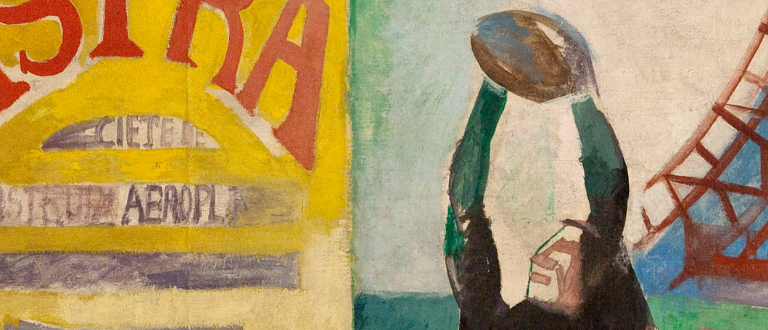
Painted at the very beginning of the 20th century, Robert Delaunay's The Cardiff Team (1912-1913) brought sport (rugby, but also the burgeoning activity of aviation) and advertising into history painting, in a Cubist vein, making this an emblematic work of the painterly avant-gardes. Previously, the traditional subjects of large-format paintings were drawn from the past: mythology, history or religion.
Enrico Prampolini's Le Charmeur de vitesse (1930) demonstrates the Italian Futurists' predilection for subjects celebrating a dynamic modernity based on technological advances. The painting depicts a long-distance runner seemingly transformed by his own motive power as it sweeps him upwards. In his "'aeropainting" manifesto, which reveals his passion for flight, the artist cites this work as an example, calling for a surpassing of the limitations of earthly reality. Here, aerodynamic impetus brings liberation from gravity.
- Through
- 25 August 2024
- Venue
- Modern Art
- Address
- 3 Place de l’Alma 2nd floor
75008 Paris
- Hours
- Only by appointment