

 Back
Back
Driftworks
Artists
Rafal Skoczek
Press release
Oskar Weiss is pleased to present Driftworks, Rafal Skoczek’s first solo exhibition with the gallery.
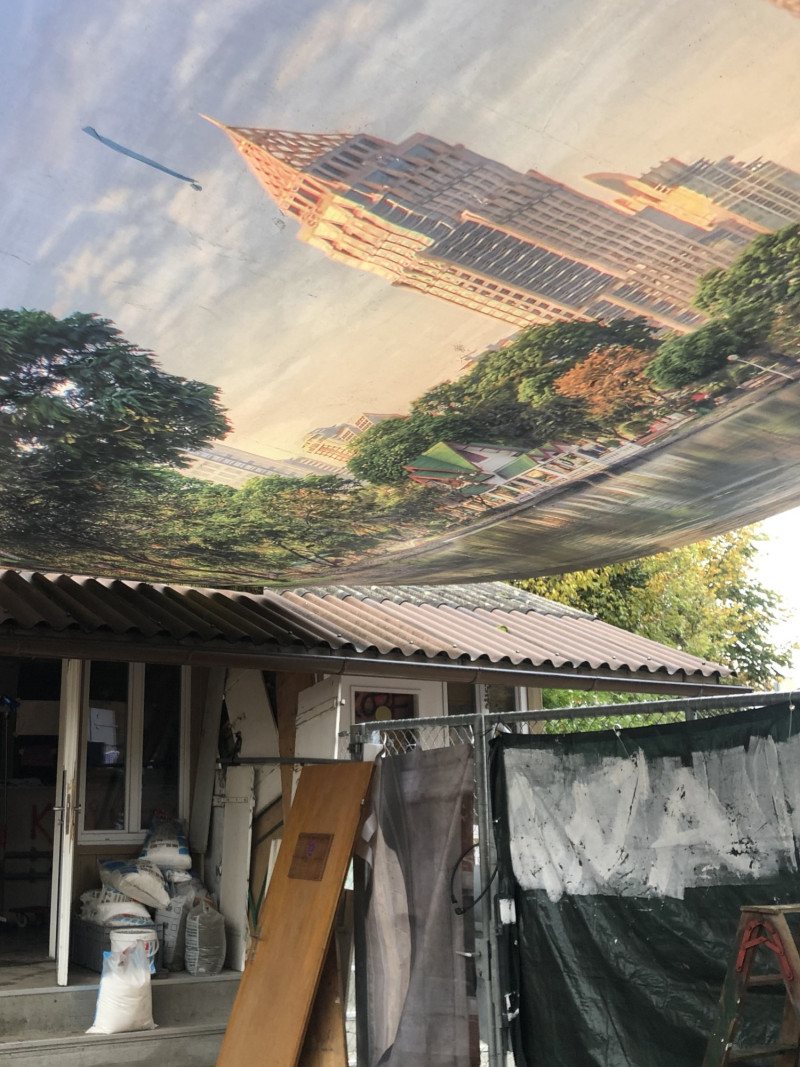
Built as barracks for migrant workers in the 1960s and repurposed for asylum seekers in the 90s, Juch Areal lay forgotten on the outskirts of Zurich until it was taken over by a group of squatters, including Rafal Skoczek, in a brief occupation in 2019. Their eviction and its demolition came the following year. In little time the artist had set up a library of anarchist literature and co-authored a documentary about the site, Menschen in Baracken, which, like much of his own work, maps the symbiotic relationship between a centre and its periphery, examining the means by which one contains the other, consciously or not.
Early on, that work included sculptural mockups of urban design proposals for keeping the homeless away or youth at bay. These ‘Post-Disciplinary Techniques’ often appeared in institutional settings, as if returning the city’s own exhibitionary modes of eviction to it. But in 2018, his parodic remake of an anti-loitering Mosquito Alarm, whose enervating frequency is only audible to ears under twenty-five years old, went seemingly unheard by the judges who awarded him the Kiefer Hablitzel Prize that year.
In recent work, sound features less as a tool of displacement and more as a psychosocial metre. Recording projects taking place in a network of tunnels running beneath Zurich, imagined as a concrete horn, have produced an acoustic cartography of city limits. It’s also through sound that his graphic work, which first surfaced in the form of event flyers, has become more prominent. The jammed-xerox aesthetic he is now well-known for evolved from an intuitive misuse of a 1970s Opterla Optesomat, a portable wax-coating machine which he distorts with all manner of UV-reacting pigments, lacquers and tar, and physically manipulated in the process of printing.
When these prints started to form the basis of paper-on-panel paintings in 2022, the names, dates and venues they once advertised disappeared leaving waveform, Op-art abstractions that suggested a city reduced to an inhospitable frequency, or altogether abandoned. Recent paintings, more legible as landscapes (by their format), pan away from urban static to sparse, peripheral wastelands.
Free of the signifiers that would otherwise align them with a social event, they gesture toward a model of art that Jean-François Lyotard proposed in the aftermath of May ’68; one that, instead of reasoning with established systems of representation or providing articulate solutions, would tap into the viewer’s phantasies, the figural, the here-and-now.¹
How such an art distinguishes itself from the type of abstraction that has historically invited a gaze away from social reality is the contention of Skoczek’s current work. In one sense, it is addressed materially, through his insistence on exhibiting the cumbersome infrastructure of an itinerant life: automobiles lived in, plywood beds slept on, the shelves of a bookshop kept alive in various guises across the city over the last five years.
In another, it’s explored through new signifiers that misdirect the readings coming out of, or projected onto, the images. If the phrase stretched across the face of the most recent paintings—Belle Estate, ‘beautiful summer’ in Italian—conjures that time of year for an affluent escape to the periphery or a bourgeois fantasy of the art-life, it also ambivalently pivots on its misreading in English, one that allows ‘beautiful property’ to emerge as the material potential of a stressed length of packing tape.
Matt Hanson
Rafal Skoczek (*1989 Bystrzyca Kłodzka, Poland), lives and works in Zurich. His work has featured in solo and group exhibitions at venues including Galerie Oskar Weiss, Zurich; Plymouth Rock, Zurich; XYZ Collective, Tokyo; Mikro, Zurich; Stadtgalerie Bern; Kunsthalle Zurich; Kunsthaus Glarus; Centre d’Art Neuchâtel; Diana, Los Angeles; Les Urbains, Lausanne; Kunsthalle Friart, Fribourg; and in Shindisi, Tbilisi. He is the co-founder of the exhibition space Chickentown, the independent publishing house E.G.G. (Edition Gora Gora) and the music label Czarnagora.
1 Lyotard, Jean-François. “Notes on the Critical Function of the Work of Art.” (1970). In Driftworks, ed. Roger McKeon, 69-81. New York: Semiotext(e), 1984.
- Through
- 24 May 2025
- Venue
- Galerie Oskar Weiss
- Address
- Sonneggstrasse 82
8006 Zurich
- Hours
- Thursdays & Fridays, 1–6pm Saturdays, 12–5pm and by appointment