

 Back
Back
The Ballads of a Sundial
Artists
Gonçalo Preto
Press release
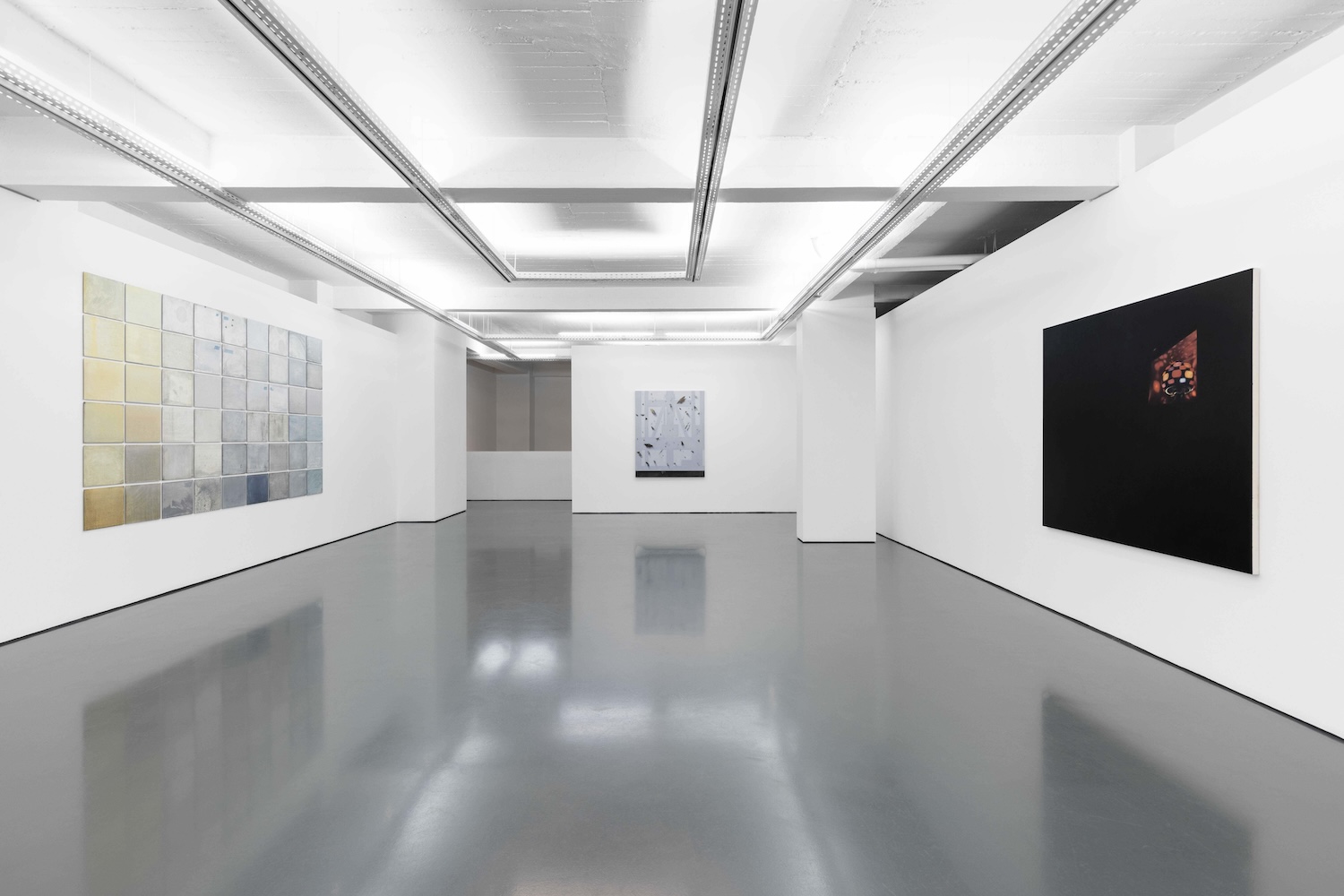
Dependent on external phenomena and on the observer's spatiotemporal intuition, the sensible inhabits a distinctly interstitial domain, straddling the real/absolute and what can be sensed. Conceived as a transitional space open to possibility, it defines the interval in which Gonçalo Preto's work is inscribed, a territory of imprecise boundaries that finds expression in The Ballads of a Sundial, his first solo exhibition at Pedro Cera. Against this backdrop, the sundial operates both as metaphor and mechanism; as one of the earliest instruments for measuring time, the projection of its gnomon onto a surface traces a cadence structured by the interplay of light (day and presence) and darkness (night and void), from which emerges penumbra as a liminal, intangible zone where all remains latent, lingering close to its origin. In the partial dialogue between light and shadow, Gonçalo Preto's paintings venture into a parallel and ambiguous field, planned with meticulous attention to detail. Taking the concept of a ballad – understood as a tale or poetic narrative – as his point of departure, the artist breaks with linear progression to create a path permeable to contingency. Its epitome finds expression in Bank of Senses I and Bank of Senses II, where the covers and pages of one – or perhaps two – books present themselves as imprints of the artist's studio sessions. As archives of sensation, these works seem to preserve stories left unrevealed or guided by uncertain logic, whose plot both obscures and illuminates the small, ambiguous elements evoking imagination and reminiscence. Accumulation appears in the exhibition without apparent coherence, as disparate visual references arrange like fragments of diverse scales and temporalities, a hallmark of Gonçalo Preto's particular artistic approach, where no image exists in isolation; the creative process itself becomes a space of drift, of continuous addition and subtraction, where each mark is constructed through the relation between units. Like a cinematic montage that does not unfold sequentially but collides in chain reactions to forge new connections – revealing the artist's interest in the Soviet cinema of Sergei Eisenstein and Dziga Vertov – The Ballads of a Sundial opens onto the inexhaustible potential of interpretation and the desire to reveal the strata of a layered, elusive world. Under the impulse of a poetic reverie, the observer is met with glimpses that unfold freely. Bathed in dim light, time slows, transforming the act of perception into an experience at once attentive and dispersive. Within this constellation, we are immersed in atmospheres that traverse and transport us to alternate universes, echoing the passage evoked by Planet Caravan or Rockstar (After V.C.) – otherworldly dimensions that escape the pictorial plane, becoming black holes or fissures capable of both absorbing and flooding the space of perception. Here, another of Gonçalo Preto's guiding concerns re-emerges, rooted in his interest in exploring the limits of the artificiality inherent to a medium that, from its inception – as recalled by the emblematic dispute between Zeuxis and Parrhasius – has been conceived as a realm of illusion. Yet if artificiality can operate as a liminal point of passage between one domain and another, it can also reveal itself as a device of optical rupture. Double Trouble unites the same silhouette in imprecise variations of luminous and opaque reflections, through which the double appears as a trace of absence; meanwhile, O Canto do Trovador establishes a shadow box whose illumination is directed both directly and diffusely, displacing any spatial reference within a formal harmony sustained by a subtle inversion of order. Arranged in circular configurations, the insects suggest a reading not immediately apparent, clustering upon a white surface that alternately reveals the supporting easel and seems to project its image back onto it. The diffused glow, where anything becomes possible, returns to the pictorial discourse, heightened by the choice of an entomofauna inspired by scientific illustrations, images of other images. Drawn to the simulated light, these creatures move like an audience to the troubadour-like cadence of the artistic gesture, questioning how far attention extends in the production of meaning. Between dissonant angles, absent horizons, and other mediating devices, the instant and topology of painting dissolve, merging with the flow of experience. The relationship with photography runs fundamentally through this body of work. Framing, the manipulation of light, and the possibility of multiple dimensions grant Gonçalo Preto an infinite freedom of organization and displacement, strategies, however, inverted and calibrated; each piece is presented at real scale to establish a direct, physical relation with the perceiving body. Envisioned as an illusory field, his work revisits the pictorial tradition of a window open onto the world, whose logic is structurally adopted in Intempéries, a 54-panel grid. By assuming the real proportions of the window through which the artist passes daily en route to the studio, the work retains the passage of time like a sundial that articulates a linguistic play – or, in Gonçalo Preto's words, a "visual pun" – capturing not only a capsule of time, but a capsule of gesture that, without intending to represent reality, ultimately transcends it within the sensible. There are three chapters to this endless (or purposeless) ballad: light, time, and memory. In each, the titles are carefully chosen to suggest a direction and then subvert it, activating the observer as a decoder of liminal environments, while objects appear personified, summoning fragments of personal memory. Space and time cease to present themselves as stable coordinates, instead emerging as alienated or subtly disturbed, as if each painting were to establish its own regime of duration and orientation. In the silence of a seemingly stagnant microcosm, Gonçalo Preto's works vibrate at an almost inaudible frequency, a hum that suspends the absolute and returns it to the penumbra of what has been revealed and of what remains yet to come. — Gonçalo Preto's painting occupies a mysterious space between technical virtuosity and its subversion, informed by an engagement with photography. Shadow and penumbra emerge as fundamental elements of the tense atmospheres his works conjure, unfolding across scattered narratives that shape a pictorial universe grounded in absence and immateriality. Light sources, darkness, close-up framing, or blurriness operate as methods that sustain a discourse in which the visible is constantly threatened by its own dissolution, evoking an indecipherable temporality marked by fragments of memory and reconstructed images. Embracing ambiguity as an expressive force, Gonçalo Preto's work proposes an atmospheric density where vision is continually challenged by the unnamable and the imperceptible. Gonçalo Preto (b. 1991, Lisbon, Portugal) lives and works in New York. In 2024, he completed his Master of Fine Arts at the Rhode Island School of Design, having previously studied at the Academy of Arts of the University of San Francisco, USA, and at Kassel Kunsthochschule, Germany. He holds a Bachelor of Fine Arts degree from the Faculty of Fine Arts of the University of Lisbon and was awarded a Fulbright/Carmona e Costa Foundation Fellowship (2022–2024). Recent solo exhibitions include Phantom Limb (2024), Andrew Reed Gallery, Miami, USA; A Cadência de uma Chama (2024), Middle Finger Pedestrians (2019) and FRAG-MEN-TO (2017), Galeria Madragoa, Lisbon; and LIMBO (2019), Museu Carlos Machado, Ponta Delgada (São Miguel), Azores, Portugal, among others. In 2025, his work was presented for the first time at Galeria Pedro Cera as part of the group exhibition On Immanence. Other recent group exhibitions include Out of Frame (2025), Jack Barrett Gallery, New York, USA; Prophetic Dreams (2024), Kutlesa Gallery, Goldau, Switzerland.
- Through
- 19 May 2026
- Venue
- Galeria Pedro Cera
- Address
- Rua do Patrocínio 67E
1350-229 Lisbon
- Hours
- Tue–Fri 10:00–13:30, 14:30–19:00; Sat 14:30–19:00