

 Back
The Leatherman
Artists
Wolfgang Tillmans, Reba Maybury, Leonore Mau, Dean Sameshima, Herbert Tobias
Press release
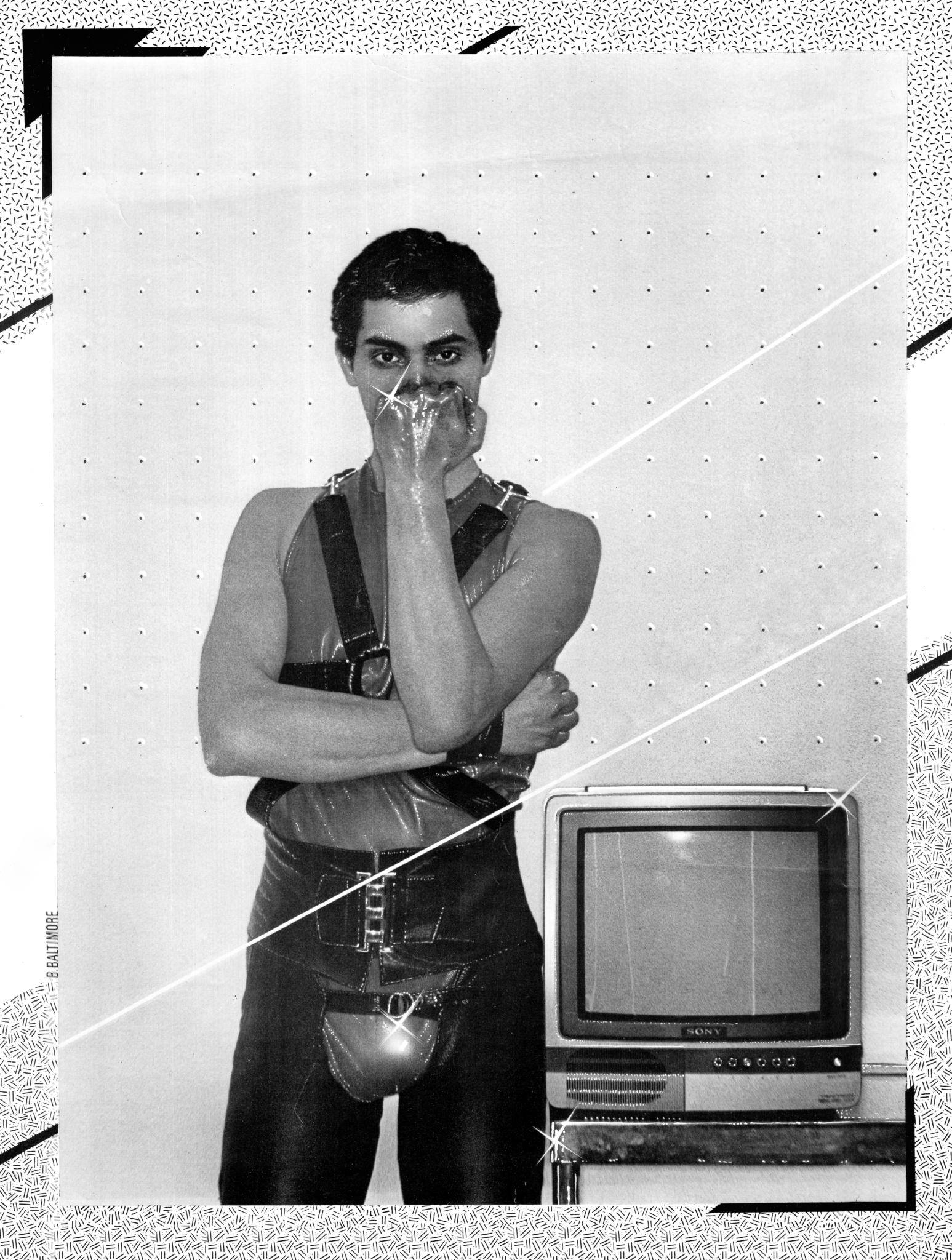
Curated by Kévin Blinderman, Pierre-Alexandre Mateos, Charles Teyssou With works by Leonore Mau, Reba Maybury, Dean Sameshima, Wolfgang Tillmans, Herbert Tobias In 1978, Karl Lagerfeld designed a leather costume for Peter Chatel's theatrical adaptation of The Leatherman. The play itself would almost disappear. The costume did not. Chatel's project had begun with Der Leatherman spricht mit Hubert Fichte, published in 1977 by the German writer and ethnographer Hubert Fichte and Hans Eppendorfer. Composed of three highly fictionalized interviews conducted over several years, the book occupies an unstable territory between confession, ethnography and self-invention. Born Hans-Peter Reichelt, Eppendorfer had already transformed himself repeatedly: murderer, prisoner, writer, leather dominator and chronicler of St. Pauli's underworld. Even the notorious account of murdering an elderly woman because she resembled his mother was stylized through the interviews, making it increasingly difficult to distinguish testimony from literary construction. Long before Chatel brought him to the stage, Eppendorfer had already turned his own biography into a performance. The Leatherman has never really stopped changing costumes. Premiered by Peter Chatel at the Théâtre du Lucernaire in Paris in 1979, the adaptation transformed Fichte and Eppendorfer's interviews into a three-act monologue, performed principally by Michel Albertini, with Chatel appearing as both director and actor. Conceived less as a conventional play than as a theatrical dispositif, it condensed incompatible temporalities into a single space: archaic ritual and television aesthetics, leather mythology and the Wirtschaftswunder, the lingering shadows of Germany's recent past and the invention of new homosexual identities. Hamburg gradually ceased to function as a setting and became the play's central character. Rainer Werner Fassbinder reportedly considered staging the work himself, while the presence of Daniel Schmid's camp and baroque cinema situates The Leatherman within a broader German-speaking constellation in which theatre, cinema, fashion and performance continually passed into one another. Paris embraced The Leatherman. The rive gauche intelligentsia applauded it. Fashion adopted it. Nightlife recognised itself in it. Basement theatres. Dangerous boys in black leather. Philosophy after midnight. West Germany as an aesthetic proposition before it became a political memory. It accumulated legends almost as quickly as reviews. What remains has become the exhibition itself: Karl Lagerfeld's original costume, archival photographs, scripts, stage props, television documents, rare ephemera and Michel Albertini's testimony, each carrying the play across media, generations and contexts. Hubert Fichte suspected that entire cities occasionally hid inside a single biography, and that Hans Eppendorfer's life might ultimately reveal more about Hamburg than Hamburg could ever reveal about itself. The Leatherman begins there. In a harbour city where leather dries slowly. Rain lingers on black jackets. St. Pauli unfolds less as a district than as an atmosphere: the Reeperbahn at dawn. Dance hall. Docklands. Fairgrounds. Rooms rented by the hour. Strip clubs. Basement bars, Inexpensive hotels. Harbour fog. Cheap cologne. The persistent feeling that every street might already belong to someone else's story. Within this landscape, the leather scene appears less as an identity than as a discreet system of recognition. Leather ceases to be a fetish. It becomes a language. Jackets. Boots. Motorcycles Clubs. Bars. Shared ceremonies. Leather has always looked better under bad lighting. Rather than illustrating Peter Chatel's production, the exhibition completes, complicates and occasionally contradicts its original intuitions, shifting The Leatherman beyond the theatre and into other histories, other bodies and other visual languages. Herbert Tobias returns to the Hamburg of the late 1970s, where these questions first became visible, photographing harbour construction sites, cruising grounds and anonymous encounters before AIDS transformed these infrastructures into historical documents. Wolfgang Tillmans belongs to another generation. The ashtrays are still full. The faces disappear into condensation. Memory appears less as a monument than as a pale afterimage, filtered through the bleached visual language of post-punk, photocopies and underground print culture. Leonore Mau quietly transforms ethnography into a portrait of the ethnographer himself, photographing Hubert Fichte as one body among others until fieldwork reveals itself to be as much a practice of desire and presence as of observation. Dean Sameshima pushes reductionism to its limit, condensing an entire erotic culture into the single word Anonymous, where the disappearance of identity paradoxically becomes its most recognisable sign. Reba Maybury introduces the perspective Peter Chatel's production never possessed, replacing masculine fraternity with the authority of a female dominatrix. Her Sub Penis Prints, produced by her submissives, register bodily traces that oscillate between abstraction, authorship and evidence. Following the successive translations through which a life became a book, a book became a play and a play eventually became an exhibition, The Leatherman returns once more as a theatrical dispositif. If theatre disappears at the end of every performance, its afterlife only truly begins the following morning. Rather than reconstructing a lost production, the exhibition follows what remains: archives, rumours, costumes, images and memories through which a vanished social world continues to circulate. Many of the spaces that once sustained queer life have disappeared, while AIDS brutally interrupted many of the networks of transmission that sustained these communities.. The Leatherman therefore approaches exhibition-making as a form of ethnographic enquiry, not to resurrect the past, but to ask what forms can still be transmitted once the world that produced them is gone. On 16 October, the Kölnischer Kunstverein, in collaboration with the Cologne club King Georg, will host a public conversation about Hubert Fichte, Hans Eppendorfer and The Leatherman. Critic Diedrich Diederichsen and artist Lili Reynaud-Dewar will discuss the book, the play and the open questions they continue to raise.
- Through
- 29 November 2026
- Venue
- Kölnischer Kunstverein
- Address
- Hahnenstraße 6
50667 Cologne
- Hours
- Tue-Sun: 11:00-18:00