
 Back
Back
HOLD
Artists
Andria Dolidze
Press release
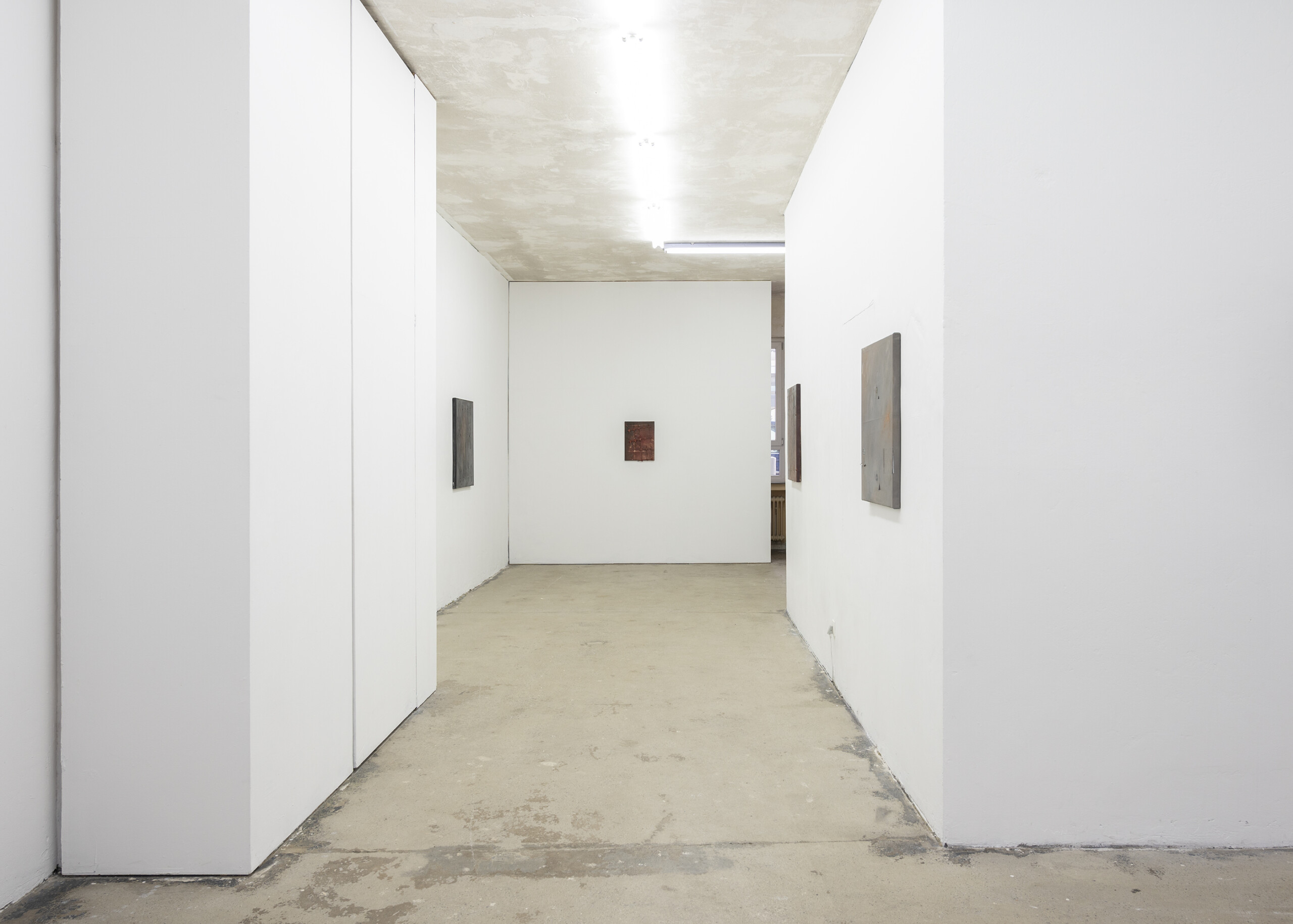
My text is a tentative attempt to trace the possibility of an encounter with Andria Dolidze’s work – to create a conversation between his images and my words. The closer I get to his painting, the more I turn towards other voices: he sends me excerpts from Italo Calvino, and I find myself reading Fernando Pessoa, Bruno Latour, and Keller Easterling – a wandering through pages, a brief pause, and then moving on. A form of writing as mapping – an attempt to approach Andria Dolidze’s exhibition at Lucas Hirsch on Birkenstraße 92 in Düsseldorf through language. In doing so, I repeatedly move beyond the surface of the page, beyond the exhibition space, and outward – toward the places where his images also find their origin. On his walks through cities, Dolidze collects objects, patterns, forms and ornaments. He photographs architectural details, fences, surfaces – a kind of urban archive. These images point to infrastructures we move through every day – choreographies that guide our movements without our being consciously aware of them. They function as boundaries or thresholds, directing flows of people, of gazes, of meanings. The canvas of the exhibited paintings points outward: banners have been cut, fragmented, and now serve in smaller formats as the foundation for Dolidze’s painting. These banners once hung on public façades – declarative media that communicated visually and textually. Now they form the first layer beneath many other layers of paint, covered, reinterpreted. Fragments of the original material still flicker through – traces, clues, possible references. The painting becomes a sediment of colour that overlays writing, imagery, and meaning. The surfaces of his paintings evoke a sense of oxidation–aged copper or bronze, a patinated aesthetic. Rust, metal, impermanence – grids and mesh patterns stretch across them. They reach beyond the edge of the canvas and extend into the exhibition space. These structures seem like portals – not as mere decoration, but as indicators of decay, of finitude, of boundaries. Of inside and outside, of inclusion and exclusion. It is about a constant interplay, a relationship between things – a relational way of thinking. This dynamic becomes visible in the ornaments, recurring patterns across his paintings. They structure the gaze, setting a rhythm of looking in and through. In Dolidze’s works, they take on various forms – fragmented, dense, loose. They mark thresholds and at the same time seem to move through his paintings, interconnecting them
In his work Exfoliate, they remind me of an arched window made of weathered metal – I cannot see through. The layers of paint obscure the view; they are dense, dark, absorbing. There’s something dreamlike about them. At times, bright flashes of oil paint break through their depth. Andria sent me excerpts from Le città invisibili (1972) by Calvino. I keep returning to them. They are about the city of Octavia, which hangs over the abyss – its structure lies beneath it, invisible, a net that holds everything. A suspended system that seems stable, held by something hidden, yet always on the verge of tearing. In this context, I read the Georgian word ბადე – net. It refers not only to a physical web but to a system of connections, memories, movements, and spaces of meaning. Like a silk thread, it points to what fades, what binds, what excludes. Octavia may float above the abyss, but everything remains connected. And the net holds only for a certain time.
No other structure than this hanging city […] seems so much to embody the notion that human life hangs by a thread. — Italo Calvino
- Tabea Marschall
- Through
- 15 August 2025
- Venue
- Lucas Hirsch
- Address
- Birkenstraße 92
40233 Düsseldorf
- Hours
- Wed-Fri: 13:00-18:00, Sat: 13:00-16:00