

 Back
Back
Ernst Yohji Jaeger
Artists
Ernst Yohji Jaeger
Press release
A while ago, we asked Ernst if there was anything that he wished to tell us about the works he was making. He sent us a text that began with a dream he had in Japan last autumn. He sees his name engraved on a mirror. A hand erases the engraving, the name disappears, the reflection as well. A voice asks, “Who are you?” He doesn’t know how to respond.
This wish cannot be fulfilled. If he names it, he’s afraid of ruining it. So, instead I live (and I paint), he writes.
We are his gallery. We ask him things like this, we request things, we plan exhibitions, we anticipate, we program, we prepare our walls. And we wait. Ernst knows this, and he lives this expectation as pressure, which is right, because it is. The condition of visibility. What took us time to understand is that this pressure is exactly what he has to struggle against in order to paint. For his process cannot be summoned, it can only be received. He needs time. We postponed his exhibition, we organized other ones, very beautiful ones, at rue des Cascades and rue de Beaune, where we were able to recover the space of Alain Finard, with its spot-lit vitrines, tinted mirrors, and velvet walls, that we then renovated so as to connect this new space with the one next door.
The day before sending the works, because I had been listening to it on repeat, and it made me think of his paintings, without really knowing why, I sent him a song on Signal. Diamonds and Rust. A song about memory, what it transforms, and what it leaves behind.
We both know what memories can bring
They bring diamonds and rust.
I didn’t think that this song would lead to Ernst elaborating such a deep reflexion on painting, his own painting. Rust, in his thoughts, it’s everything that happens, “our history, our body, our relation, our age, our name.” Oxidised, decomposed, that which depends on time in order to exist. Diamonds take time to form but as soon as they do, they are eternal, as we say, leaving the colour of light to pass unchanged through its structure, refracting it in a unique way without tinting it. Light, here, is to be understood in its symbolic aspect, “that which the conscience brings in order to materialise.” All of a sudden, this pairing – rust and diamonds – becomes a key to unlock meaning. The paintings are also made of rust, he tells me, “but they are steeped in conscience. In the best of conditions, we can feel the presence of diamond.” They point towards something. They are like an offering, an honour returned. And this is where the tension of our position as gallery becomes ambivalent – because Ernst is very clear about the risk entailed: “The paintings become like the living-dead, seizing up, becoming uncreative when they confuse their responsibility as rust rather than as diamond.” Deadlines, pressure, reputation, our expectations, — all of this is rust. The painter who gives into this, loses his way. I understand. We still continue to wait for the works.
The act of sitting down to paint, he tells me, “contains all the struggles to free that which we believe to be in favour of something bigger.” It’s a deathly process. For Ernst, trusting the process is like a slow death. But through this death, something is born, “something new, that you could have never thought of. You couldn’t.” Herein lies the difference between a sacrifice and an offering, between resistance and letting go, exactly here.
There is something special about Ernst: the symbolic things that he talks about, they aren’t abstract. He lives them. He tells me about a meditation session in Japan, informed by a technique where you project your own death, where you must say goodbye to everything, to your children, to your body, to your parents. He has a vision: he transforms into a phoenix. The next morning, while out for a walk, he crosses a red bridge, and finds himself before a temple that he didn’t know was there. Behind the temple, dozens of phoenix sculptures. “What the hell is this?” He laughs as he tells his story, conscious of its absurdity. But it really did happen.
This is how he understands the myths that paints, coming to the surface of his paintings in this exhibition – the snake, the whale, the phoenix. These are “objective structures of reality,” patterns for the ways in which things happen. “When a whale swallows a prophet, when a whale appears in Moby Dick, it’s always truth, not fiction. The cosmology functions, whether you believe it or not.” And painting is where these structures live consciously. “From the outside, you paint – but what is painted, this happens inside yourself.” In the work A Dream as Deep as the Ocean – at the bottom of the composition, there is a figure asleep in bed. Above, an enormous whale crosses a nocturnal ocean. On the surface, a sailboat. The two spaces exist without a border, nor a perspective. You’re in bed and on the high seas. It’s not a depiction of a dream but the structure of dream itself.
In Ernst’s studio, there is a small tree – a calamondin tree. It almost died two years ago, when Ernst was going through a difficult time, when he felt the need to stop, to take some distance. We spoke, we suggested that he leave Vienna for a bit, that he go to Japan. We saw each other there. The most personal of our conversations happened in a ramen restaurant near the flea market. We didn’t talk about deadlines, we told him that he had the unmeasurable luck to produce something meaningful enough to outlive his own existence, to be the maker of these paintings, that he was free, that he could choose the life he wanted to life, the painting he wanted to paint. That we would wait. The tree, which had become a leafless bit of wood, slowly, become green again. When Ernst came back from Kyoto this year, the tree had some small flowers. And while he was painting the works for this exhibition, the tree started to bear fruit – growing, as it seemed to him – at the same pace as the paintings themselves.
This calamondin tree, it’s not a metaphor that Ernst conjured up: it’s an observation. Important things are never forced, they are cultivated. Sometimes you must let something die: what you thought we were, to become who you are now. “The paintings I was making before resembled my confused and melancholic desire, without any personal clarity. Now they seem more concentrated, born from experience rather than nostalgia.” This is what is happening in And we step into the vanishing light – the profile of a silhouette before the setting sun, his dog behind him. The rays of light explode in every direction. It’s not a sunset that you’re supposed to contemplate. It’s penetrating light.
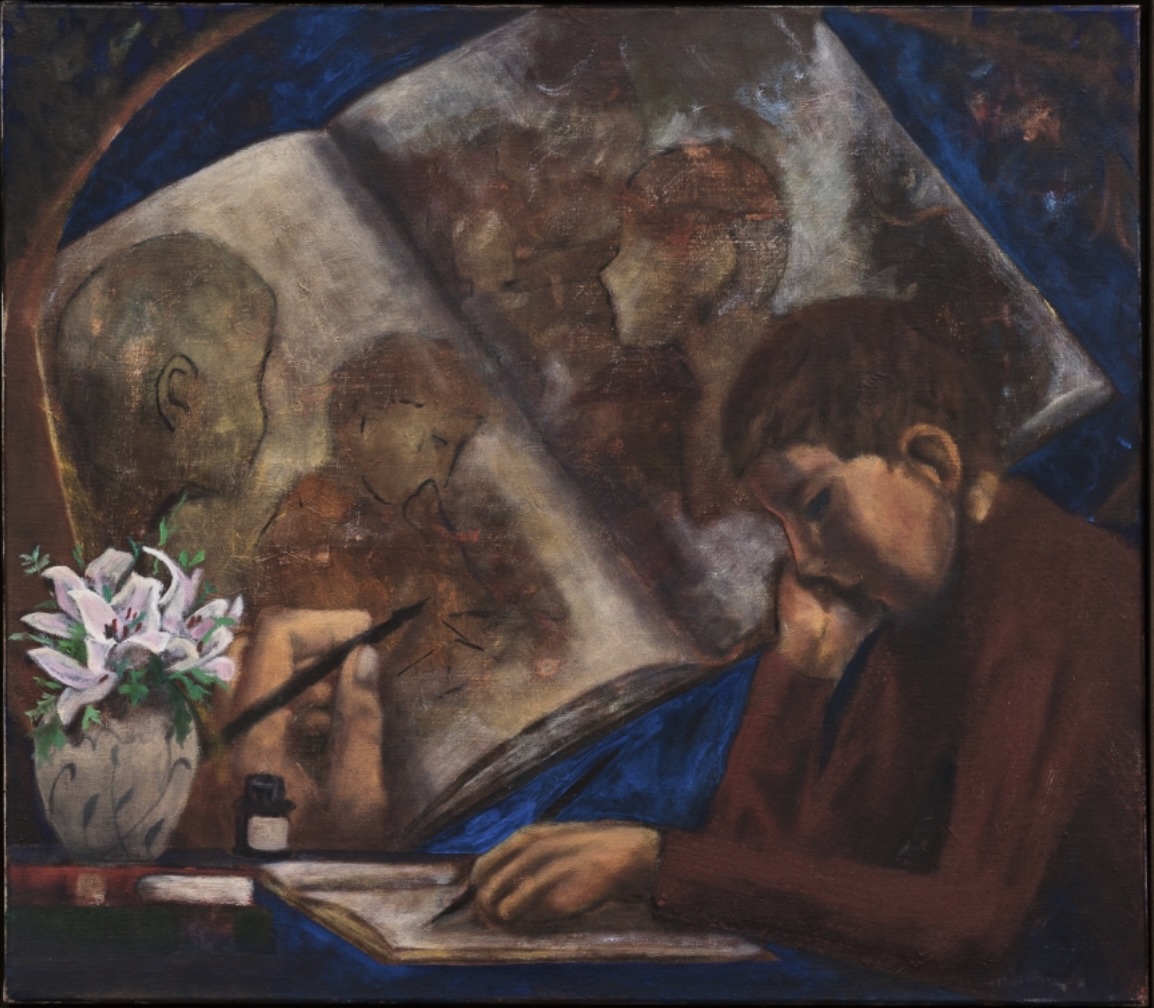
When I look at his paintings, I think of what Ernst told me about his use of brushes. “When the brush is new, it’s very precise, there is no surprise. After paint accumulates, it becomes rougher, it no longer does what you want it to – and instead develops its own character.” This is also what his paintings are like. They don’t do what you expect. They have their own character. I know that Ernst begins his paintings with a red ochre imprimatura, like Titian or Vélazquez. A ground of rust. Successive states of composition, then covered over. Most of the paintings go through different scenarios, up to four or five. This gives them both a pictorial and narrative density that is very singular. It goes in two different directions. There are two paintings in the exhibition that we could call abstract: works that attained their truth before becoming recognisable figurations, or whose pre-existing figurations were decomposed. As though the paint had gone back to its state of potential, to its initial will, as though adding something would destroy it. There are also many zones where the figurative elements dissolve into abstraction: the carpet, the bouquet of flowers. And he especially loves the precision of a medium that is simply itself (painting) and not an illusion. The opposite of hyperrealism, which claims that paint doesn’t exist, it’s only the image that matters.
Rust and diamonds, two materials that have nothing chemically in common – one being the purest and most solid form of carbon, the other being degradation, corrosion. Times produces both. We can’t separate them.
The works ended up arriving. And the walls, now, are ready.
Text: Alix Dionot-Morani
Translation: Aodhen Madden
- Through
- 25 July 2026
- Venue
- Galerie Crèvecœur - Beaune
- Address
- 5-7 Rue de Beaune
75007 Paris
- Hours
- Tue-Sat: 11:00-19:00, and by appointment