

 Back
Back
John Chamberlain
Artists
John Chamberlain
Press release
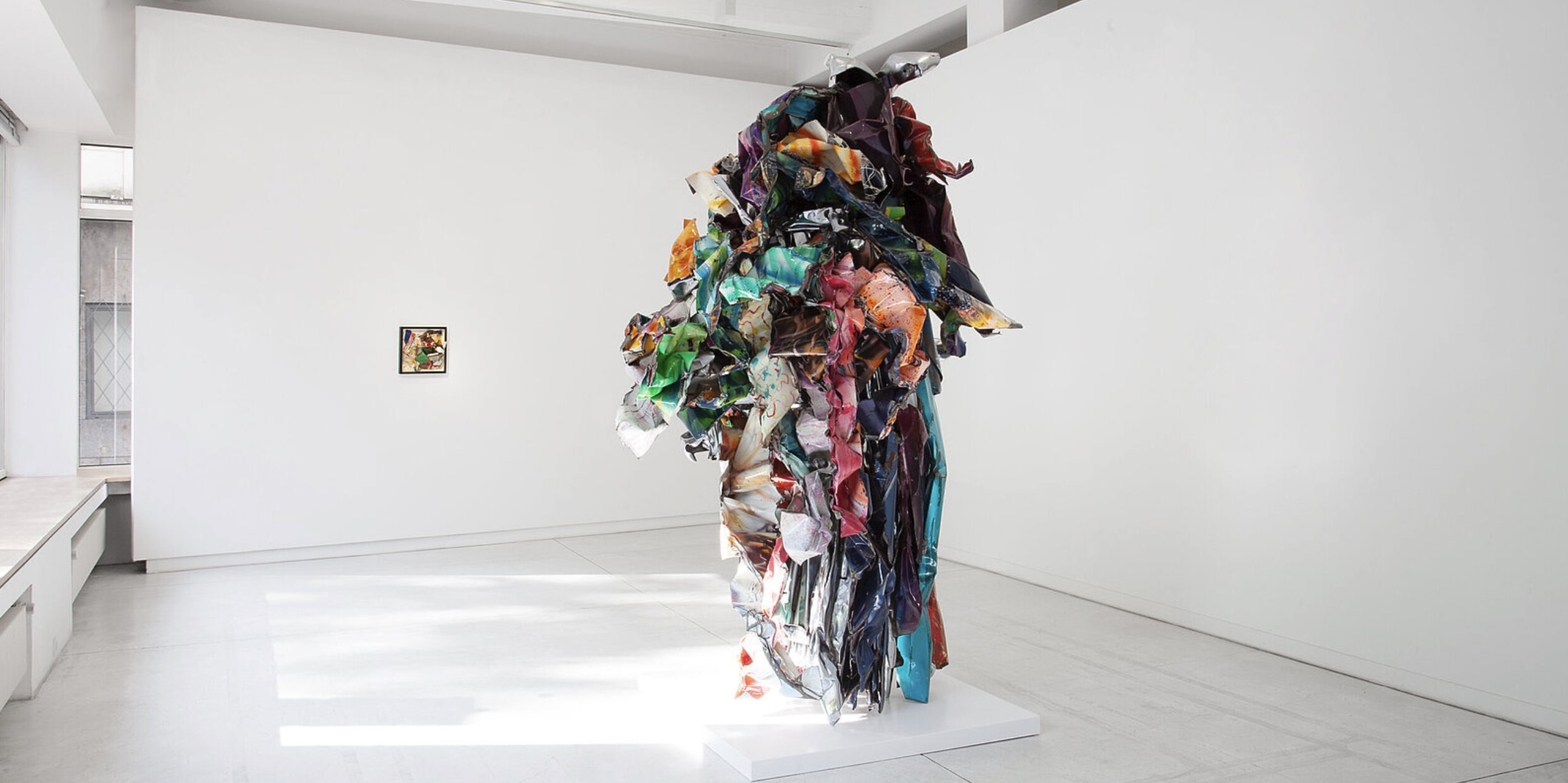
John Chamberlain (1927–2011) is one of the central figures of the international post-war avant-garde. As one of Galerie Karsten Greve's earliest artists, John Chamberlain has been represented by the gallery since 1973. Across the decades, John Chamberlain and Karsten Greve were connected not only by friendship but also by a close working relationship, which has been reflected in numerous solo and group exhibitions. The presentation brings together works from different phases since 1960, combining both Chamberlain's sculptural and photographic oeuvre. The exhibition pays tribute to a ground-breaking and uniquely distinctive work, highlighting its outstanding importance for post-war art. Raised in Chicago, amid a highly industrialized urban environment of factories, workshops, and constant automobile traffic, John Chamberlain's early life was shaped by the material realities of an industrial society. In later years, discarded industrial metal, most notably automobile parts, became the primary material of his sculptures. Chamberlain was part of a vibrant artistic community in New York in the late 1950s, where he was drawn beyond convention. Inspired by this community, John Chamberlain devoted himself wholeheartedly to poetry, experimenting with language as a direct expression of thought and perception. Detached from tradition, he questioned artistic freedom, material and form in innovative ways. Shortly after his return to New York, he created his first pioneering sculpture from car body parts: Shortstop (1957). By crumpling, rolling, hammering, compressing, and stretching metal elements, he transformed the material into intricately folded surfaces that oscillate between controlled order and dynamic movement. The densified, multifaceted surfaces of his sculptures, often interspersed with brightly colored car paint, intertwine gestural expression with industrial texture. The complex interlocking and twisting of the metallic fragments create ever-changing constellations: surfaces tilt into space, lines break off or continue, and volumes appear to expand depending on the viewer's perspective. The sculptures also exude a painterly quality — the industrial lacquers and enamels used in automobile manufacturing create a vibrant chromatic spectrum. Chamberlain developed a penchant for evocative, associative neologisms that emphasize rhythm, sound structure, and visual impact rather than specific meaning. The seemingly playful, and at times deliberately meaningless, titles function much like concrete poems. They draw attention to language as a medium, complementing the physical presence of the sculptures without defining them. In his photographic work, begun as early as in 1977, a shift in perspective plays an equally important role. Chamberlain used a Widelux camera, which is, in fact, designed for panoramic photography and requires a firm and stable hold, often supported by a tripod. However, he used it in an unconventional way: he turned and swiveled the camera freely by hand, spontaneously, almost in a playful and experimental manner. This resulted in extreme close-ups and unusual angles. The distorted, dynamic photographs destabilize space and perception. These stretched, curved or fragmented visual spaces translate his spontaneous, materials-based approach into the photographic medium. The photography and sculpture reinforce each other, forming a coherent artistic vision. Chamberlain's works are held in major international collections, and he was associated with artists including Robert Rauschenberg, Donald Judd, and Andy Warhol, who was also the former owner of Papagayo (1967). His works were featured in major international exhibitions: in 1961 and 1994 at the São Paulo Biennial, 1964 at the Venice Biennale, and in 1982 at the documenta 7 in Kassel. In 1971, the Solomon R. Guggenheim Museum in New York presented Chamberlain's first retrospective. In 1979 and 1980, his first retrospective in Europe followed at the Kunsthalle Bern and the Van Abbemuseum in Eindhoven. In 1991, the Staatliche Kunsthalle Baden-Baden presented his first retrospective in Germany.
- Through
- 18 July 2026
- Venue
- Galerie Karsten Greve Cologne
- Address
- Drususgasse 1-5
50667 Cologne
- Hours
- Tue-Sat: 10:00-18:00