

 Back
Back
Krystyna Wojtyna-Drouet: I Cease to Exist for Myself
Artists
Krystyna Wojtyna-Drouet
Press release
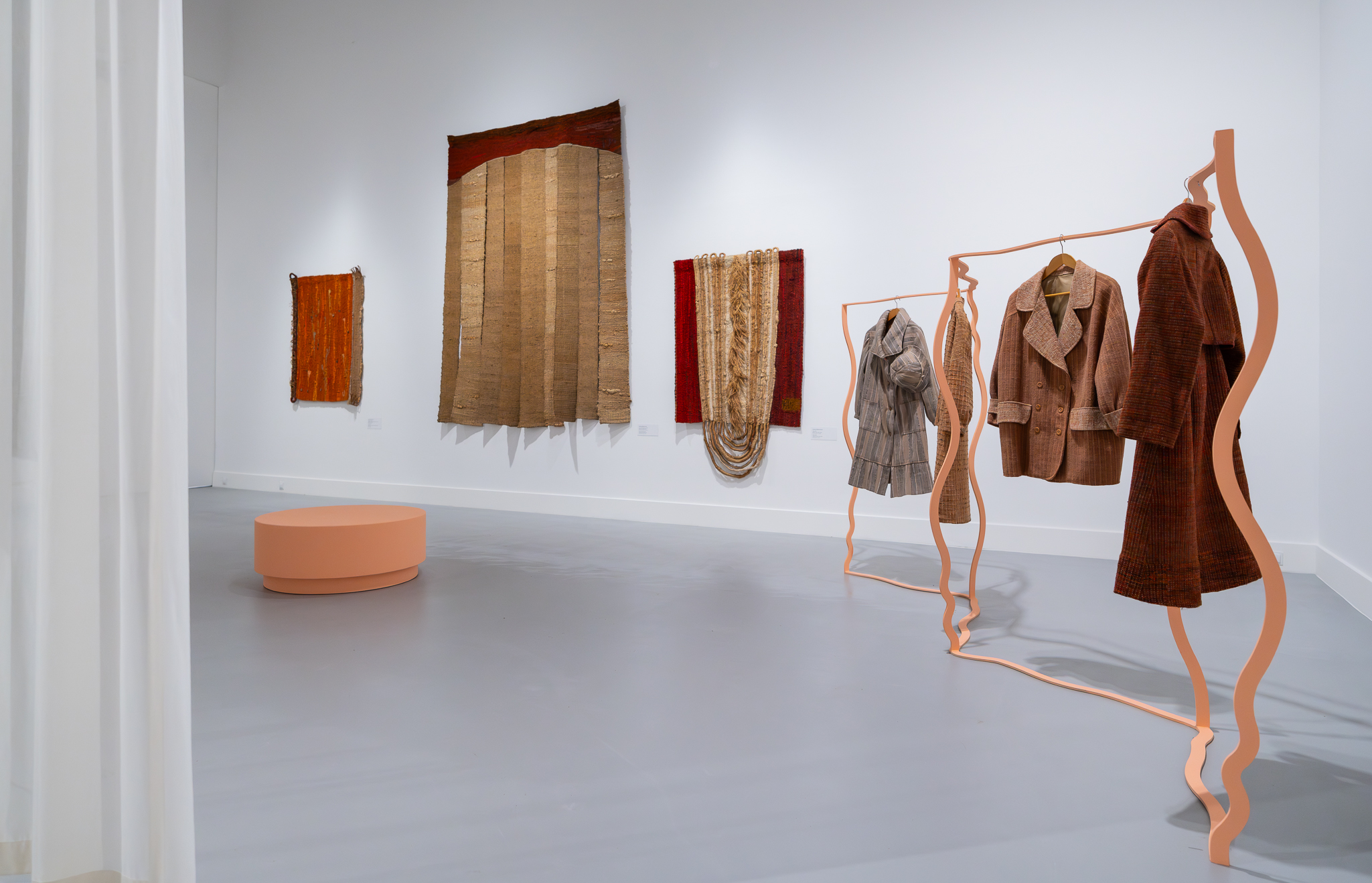
The exhibition of works by Krystyna Wojtyna-Drouet – who celebrated her 100th birthday in January 2026 – presents the body of work, spanning over seventy years, of one of the key figures of the Polish school of textile art. Her works, like those of other female artists associated with this significant phenomenon in post-war Polish art, are characterised by an experimental approach to form and material, with a focus on the visual qualities and texture of the weave. The graduates of Eleonora Plutyńska's studio at the Academy of Fine Arts in Warsaw, who formed this circle, wove their textiles by hand, using unusual materials such as partially degreased, hand-spun sheep's wool, hemp or sisal.
These textiles, which transcended the boundaries of the traditional medium, brought international success to the Polish delegation at the 1st Textile Biennale in Lausanne in 1962. The loom has been Wojtyna-Drouet's primary tool since she graduated in 1953. In her work, the weaving process itself—comparable to meditation—is of key importance. The artist selects natural, partially unbleached wool from mountain sheep, which she dyes according to traditional recipes passed down to her by Wanda Szczepanowska. Her tapestries and kilims are created without a prior technical design, intuitively and spontaneously. In preparing the exhibition, Tim Ingold's processual perspective on the study of craftsmanship proved crucial. It posits that it is not the maker who imposes a form upon the object, but rather that the object comes into being as the material itself takes on a form. This approach resonates deeply with Wojtyn-Drouet. For her, weaving is not the execution of a fixed plan subject to pre-determined rules or specific technical solutions. For the artist, craft is a way of inhabiting the world through the performative repetition of the same actions – warping the loom, dyeing the wool, the daily act of weaving, and removing the finished tapestries from the loom. The exhibition presents a selection of 20 works by the artist created between 1953 and 2018, comprising an overview of her most significant works from museum collections.
This selection is complemented by lesser-known tapestries from her private collection. Large-format tapestries, such as Uliczka (1962), created for the Lausanne Biennale, and the later Kwitnące wzgórza (1978), commissioned privately, are being exhibited for the first time in over two decades. They have been arranged to illustrate the formal and stylistic shifts in the artist's work – from figuration, through abstract compositions, to the lyrical works of her later years. At Zachęta, the exhibition features not only tapestries and kilims that illustrate her process-oriented approach to this soft medium, but also items documenting her craft: dyeing recipes, fabrics showcasing weaving techniques such as jacquard and fabric printing, and a collection of her own hand-woven garments. References to a way of life centred on craftsmanship, integrated into the art world, can be found in the works of contemporary artists inspired by Wojtyna-Drouet's oeuvre – Agnieszka Grodzińska, Maria Oblicka and Alexander Cabeza-Trigg. The exhibition, which presents both finished textiles and documentation of the workshop experience, is also situated within the context of the current revival of weaving techniques and aims to make technical knowledge, honed over the years, accessible to the next generation.
Krystyna Wojtyna-Drouet (b. 1926) – a textile artist and painter, a representative of the first generation of the Polish school of textile art. Between 1946 and 1953, she studied at the Academy of Fine Arts in Warsaw (graduating from Eleonora Plutyńska's studio). She took part in the 1st, 4th and 5th International Textile Biennales in Lausanne. In 1975, she took part in the 1st International Textile Triennial in Łódź, and in 1978 in the International Quadriennale of Decorative Arts in Erfurt. Her works have been exhibited in Poland and abroad, including in Oslo, Leipzig, Buenos Aires, Havana, Chicago and Cairo. She has created over 350 textiles. Her tapestries can be found, amongst others, in the collections of the National Museum in Warsaw, the Central Museum of Textiles in Łódź, the POLIN Museum of the History of Polish Jews, the Musée Jean-Lurçat de la Tapisserie Contemporaine in Angers, the Philadelphia Museum of Art, and in private collections both in Poland and abroad. She is the recipient of the Gold Medal for Merit to Culture – Gloria Artis (2023). In 2025, she was awarded an honourable mention in the third edition of the Prof. Stanisław Trzeszczkowski Award, presented by the Warsaw District of the Association of Polish Artists (ZPAP) with the support of the Ministry of Culture and National Heritage.
- Through
- 04 April 2026
- Venue
- Zachęta – National Gallery of Art
- Address
- pl. Małachowskiego 3
00-916 Warsaw
- Hours
- Tue–Sun 12:00–20:00