

 Back
Back
La Pensée Férale
Artists
La Pensée Férale
Press release
Esther Schipper is pleased to announce La Pensée Férale, Daniel Steegmann Mangrané’s third exhibition with the gallery and his first at our Paris location. Conceived as a two-part presentation, two solo exhibitions by the artist will take place in Paris concurrently, at Esther Schipper and at Mendes Wood DM.
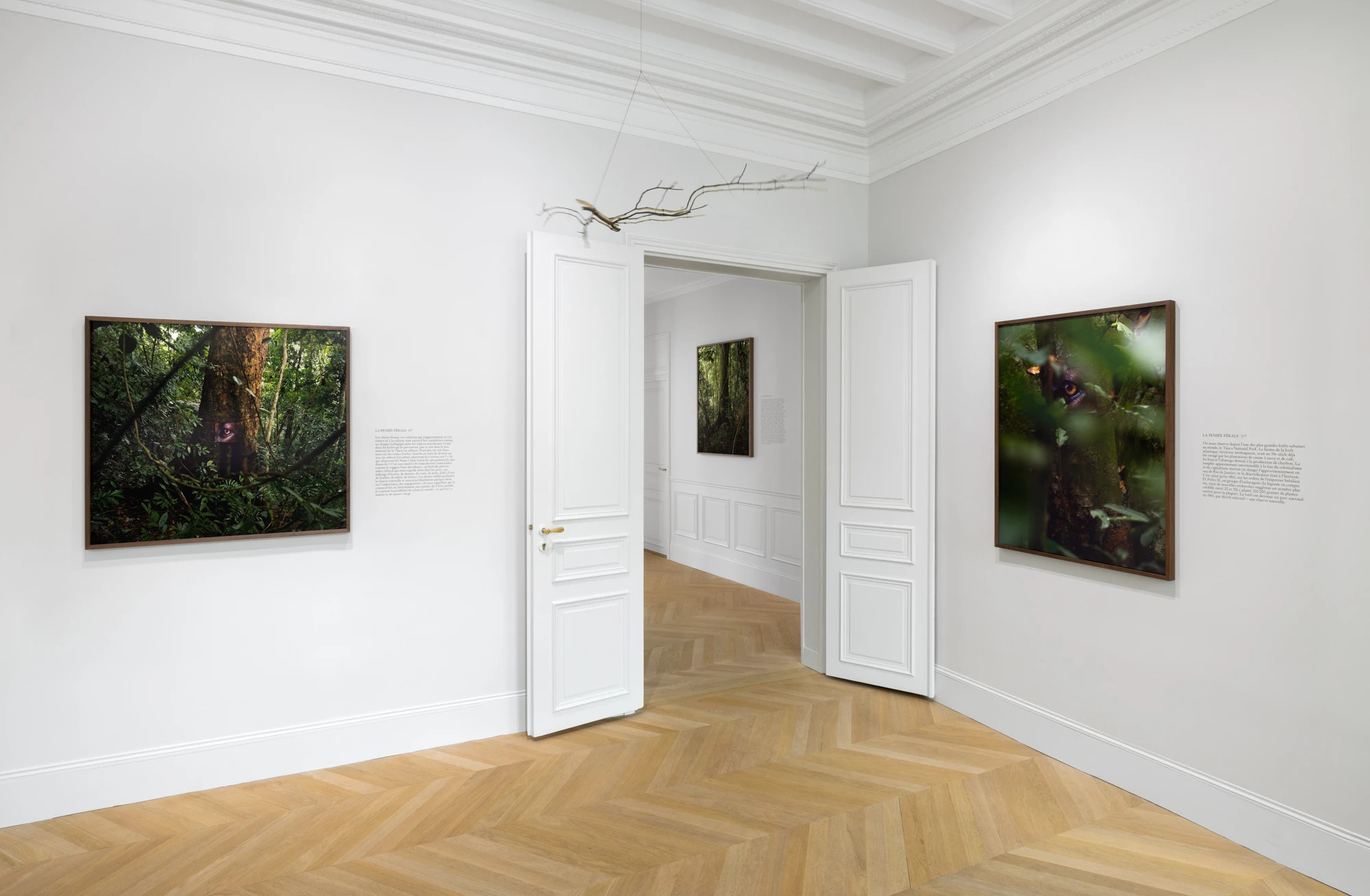
A cornerstone of both exhibitions are works transposing the eye of a dog onto a tree, whether as part of a landscape or a sculptural object made from tree bark, emphasizing a mutually transforming game of gazes, a perspectivist entanglement of looking and being looked at. La Pensée Férale then continues Steegmann Mangrané exploration of the complex relation of beings with their surroundings experienced for example in the Mata atlântica. To the artist the conditions of such rainforest environments are indicative of an entirely different mode of existence, a way of being in the world that is represented in the distinct cosmologies of Amerindian peoples and that shapes distinct notions of perspective, subjectivity, and agency. Finding poetic expressions and vivid representations of a living, soulful nature in delicate modified organic materials such as leaves, twigs or fruits, in photography and in film, the two-part presentation gives an overview of Steegmann Mangrané recent work. A comprehensive survey of the artist’s practice, Daniel Steegmann Mangrané: A Leaf Shapes the Eye, is on view at MACBA in Barcelona through May 20, 2024.
At Esther Schipper a series of seven photographs punctuate the exhibition space. The photographs were taken at the Tijuca National Park, a Mata atlântica rainforest in Rio de Janeiro. Once almost entirely depleted, the Brazilian Emperor Dom Pedro II in the mid-19 century nationalized the land and had a group of enslaved men replant the rainforest, in what was probably one of the pioneering gubernamental ecological actions worldwide. Almost entirely cut down, Tijuca still hosts some trees older than 600 years. Those giants were already in place when the Portuguese first arrived and have witnessed, in its entirety, the violent process of colonization. In Steegmann Mangrané’s works, the trees have come to stare back at us with the disembodied eyes of feral dogs.
The photographs are accompanied by short texts by the philosopher Juliana Fausto, who explores the history of this place from the point of view of the feral dogs that inhabit the forest today, and who ponders what "feral thought" might be. Drawing upon, but diverting in important ways, from French anthropologist Claude Levi-Strauss’ notion of "la pensée sauvage" which postulated the possibility of a primordial thought, untamed by (Western) civilization, Fausto imagines what our tamed thought would become if we were ever to break the chains of domestication, to decolonize and set our thought free. It won’t be a "pensée sauvage," as described by Levi-Strauss, but it may become a feral thought, according to Fausto.
Alongside the photographs delicate branches are suspended from the ceiling and presented on plinths. The different sculptures are made from split twigs or branches bisected, sometimes intertwining the two parts, as if mirrored. The graceful sculptures take on an embodied, perhaps even anthropomorphic quality, suggesting a sense of both fragility and resilience.
- Through
- 20 July 2024
- Venue
- Esther Schipper
- Address
- 16 Pl. Vendôme
75001 Paris
- Hours
- Tue-Sat: 11:00–18:00