

 Back
Back
Portrait(S): Loretta Fahrenholz, Tishan Hsu and Anna Oppermann
Artists
Loretta Fahrenholz, Tishan Hsu And Anna Oppermann
Press release
Syntax
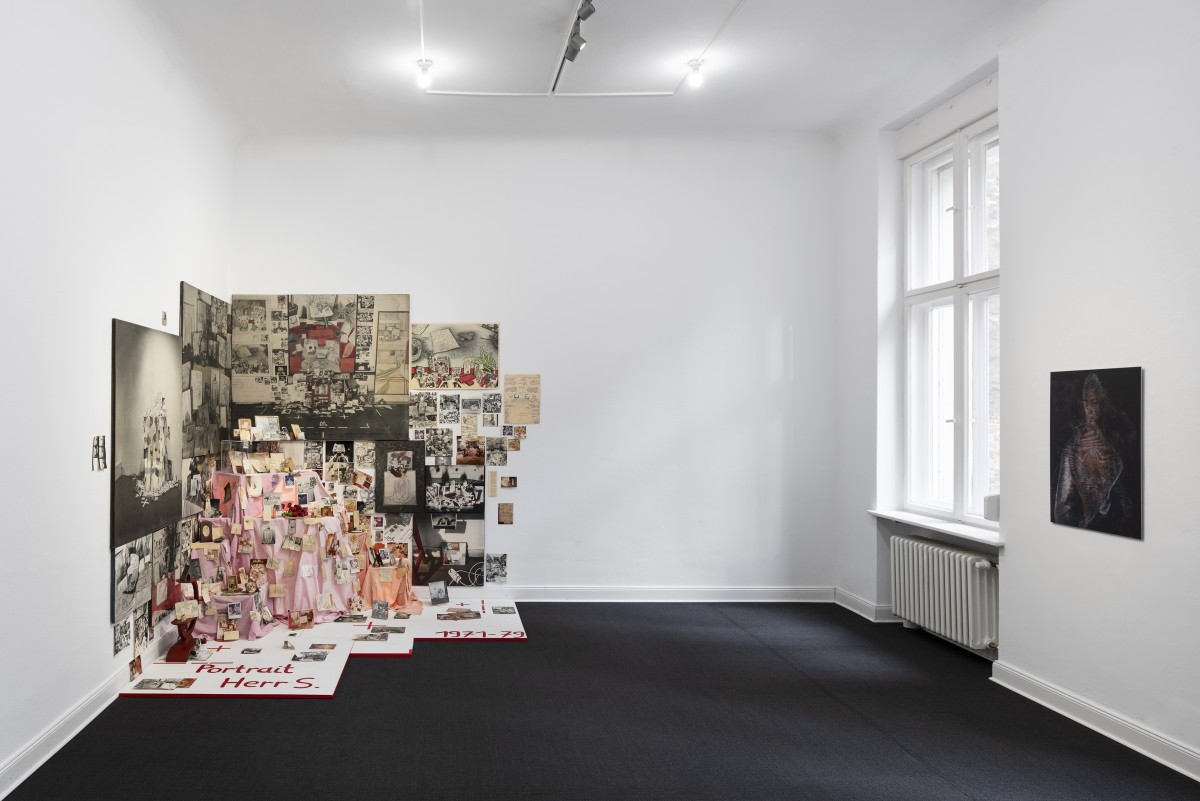
In the exhibition, all three artists transfer the (work-) body across different systems, the work thereby becomes an open interim state of archiving, remembering and self-interrogation. Their work process can be understood as the development of a new syntax, a grammar that responds to (new) media-structural conditions. These are anticipated in the work of Anna Oppermann, reflected upon in the work of Tishan Hsu and taken as a natural given in the work of Loretta Fahrenholz. Syntax here does not imply a rational overview, but rather a form of dysphoria: a network of images that refuses immediate coherence.
Portraiture
All three present a complex, networked consciousness, a polyphonic expansion of society and the art world. The works are treated like bodies and equated with them; for instance, in their materiality as skin or in their physicality as an Ensemble. Accordingly, the portrait is no longer to be read merely as a presentation of the outer surface, but also as an outward expression of the inner, the (physical) conditions of art. What in Hsu and Oppermann still appears through the politics of the personal, emerges in the work of Fahrenholz within the dynamics of a group, a specific community situated in a private space.
Simultanity of vision
The practices of Oppermann and Hsu emerge from a clearly defined spatial situation of sitting: physically immobile, with a long, fixed gaze directed at an object. Oppermann still worked within a reality that was not mediated by a screen, although her works already anticipated elements of the later fractalization. Hsu, on the other side, was economically constrained and digitized data on one of the first PCs - “It is the body, and the body in pain that creates politics.” For Hsu, the economic necessity of combining labor and artistic practice is therefore formative, while for Oppermann the socially restricted space as a woman is evident. The viewer’s perception of time is an active element in the reception of Anna Oppermann’s works; her practice combines the immobility of production with a mobility of perception. With Fahrenholz, the situation is reversed: the act of production itself is mobile and cinematic, while perception remains relatively still.
- Through
- 18 April 2026
- Venue
- Galerie Max Mayer
- Address
- Hardenbergstraße 9A, 2nd backyard
10623 Berlin
- Hours
- Tue-Sat: 12:00-18:00