

 Back
Back
Maria Jarema: Cracked Modernism
Artists
Maria Jarema
Press release
Cracked modernism sheds new light on one of the most original figures of Polish interwar and post-war modern art. Maria Jarema studied sculpture at the Academy of Fine Arts in Cracow, graduating in 1935. Early on, she joined a politically engaged avant-garde community adamant in rejecting academic norms. In 1933, was one of the founding members of the First Kraków Group – a platform of key significance to the emerging modernist generation. In the years 1934–1939, she also worked with Cricot, an experimental theatre run by her brother Józef; she was stage and costume designer, puppeteer, and actress. From early days of her artistic path, Jarema positioned herself within international modernism, adopting its shared language of post-Cubist abstraction and drawing on Surrealism and Expressionism. In the postwar period, she demanded artistic freedom, refusing to submit to the dictates of Socialist Realism and going into internal exile until 1954.
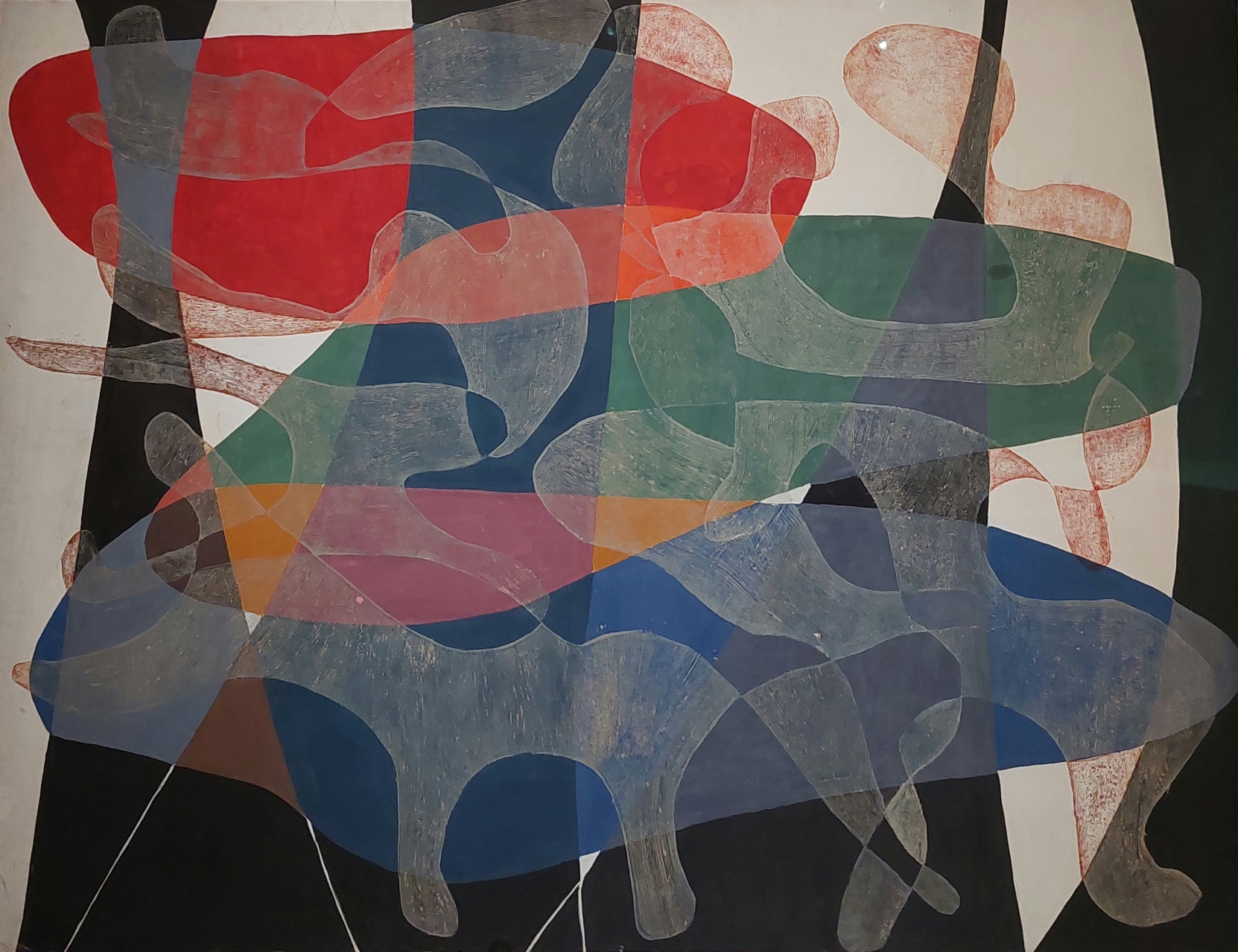
Combining the surrealist focus on corporeality and self-expression with a pursuit of the formal autonomy of abstract art, Jarema began experimenting with the monotype technique in 1949. The technique enabled her to articulate the concept of selfhood as totality, and the impossible, fragmented, cracked ambit of multiple aggressions, within and without. The curators describe the idiom she developed as "cracked modernism." The artist's work can be read as an exploration of the various situations in which the body and subject find themselves: from the experience of the individual, through relationships between two people and the family, to functioning within a broader community. The exhibition is arranged according to this escalating scale—single, doubles, family, multitude—showing how social tensions and processes of fragmentation and rupture of the subject emerge in representations of the self. It also presents works by Polish, French, Swiss, and Italian artists with which she was in a conflicted dialogue. Jarema's late series—Wyrazy (Expressions), Penetracje (Penetrations) and Filtry (Filters)—are a complete articulation of her "cracked modernism": monotype layers fused with painted translucent geometric and organic forms to produce vibrant, spatial structures suggesting motion rather than representation. From such vantage point, Jarema's oeuvre becomes an attempt to forge a new language of connection to the world—one based on an interdependence and interference of bodies, forces and vital matter.
The artist thus emerges as a persistent architect of fluid forms, capable – though facing the growing disintegration of public life and deterioration of her own leukemia-ridden body – of transforming vibrating, unstable matter into a strategy of resistance and experimentation in the field of imagination. The exhibition enables a deeper understanding of Jarema's individual practice and creative process by presenting her work alongside that of Polish, French, Swiss and Italian artists whom she admired and whose achievements she engaged with. Yet she refused to sacrifice her own voice. She knew very well that "without deformation, transposition, metaphor, abstraction—we cannot grasp or express the escalating conflicts of feelings and issues." The exhibition presents works from all periods of Maria Jarema's artistic career. For the first time in the history of exhibition-making, Cracked Modernism also includes nearly the artist's entire personal library, comprising exhibition catalogues, volumes of poetry, artists' portfolios, and periodicals—materials collected during her three extended stays in Paris, exchanged with friends in Poland, or given to her by her brother Józef. These holdings help to outline the intellectual and artistic biography of an uncompromising artist, ceaselessly hungry for experience and intellectual stimulation, who died prematurely at the age of fifty.
- Through
- 28 June 2026
- Venue
- Museum of Modern Art Warsaw
- Address
- Marszałkowska 3
00-390 Warsaw
- Hours
- Tue–Sun 12:00–20:00