

 Back
Back
Proxy – Der Bürger als Pflanze
Artists
Maximiliane Baumgartner
Press release
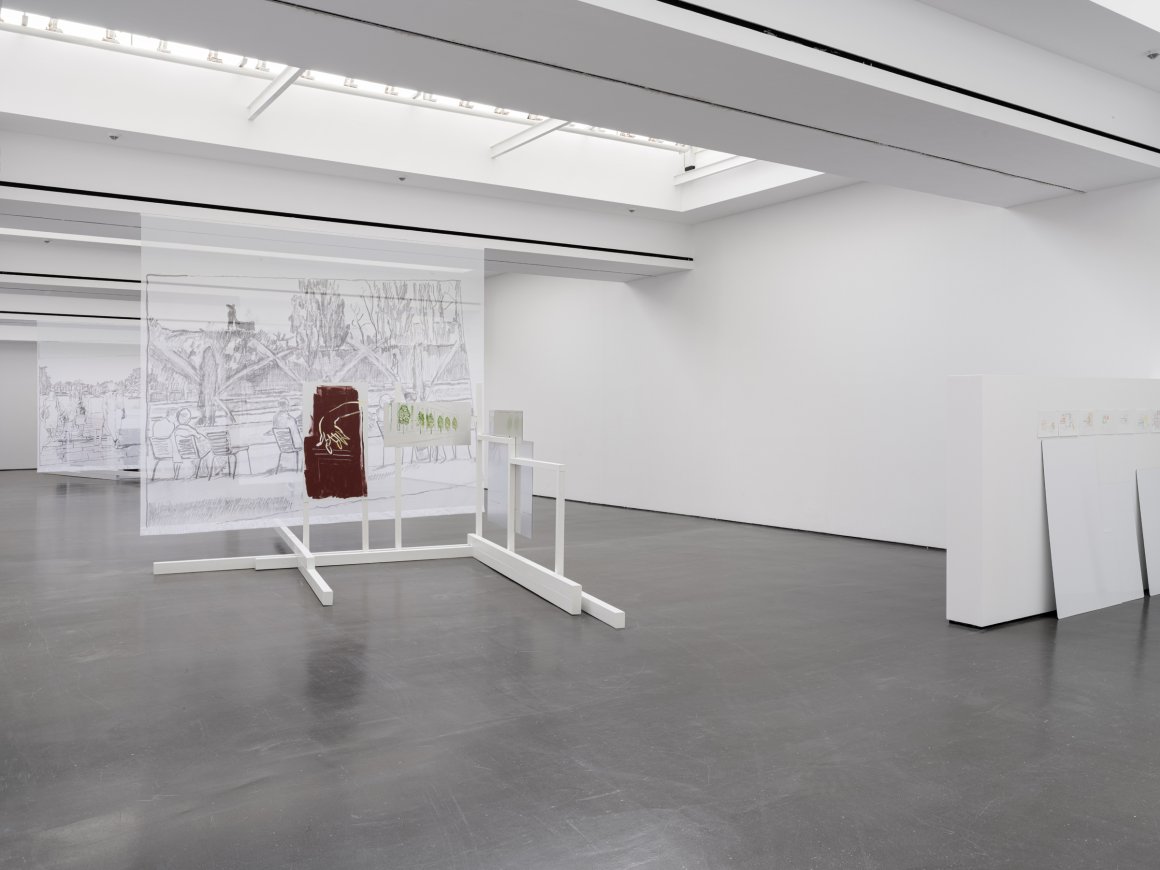
Maximiliane Baumgartner’s solo exhibition Proxy – Der Bürger als Pflanzecomprises three interconnected chapters. The starting point for the show is the artist’s longstanding interest in spatial contexts and their social, political, and historical implications in light of structural continuities from the Nazi era. By focusing on specific examples, Baumgartner examines how Nazi structures are dealt with, revealing the extent to which urban planning and architecture continue to carry ideological and propagandistic remnants long after 1945.
By connecting different temporal and spatial dimensions, the exhibition makes the overarching connections between them tangible. The works on view all formulate questions regarding the visibility and non-visibility of pictorial practices of resistance, and about the potential for critical engagement with images and spaces and their underlying power structures. The first chapter of the exhibition presents works stemming from Baumgartner’s engagement with the historic Hof-Atelier Elvira and the Nazis’ “Degenerate Art” exhibition, which took place in 1937 at what is now the Kunstverein München. The second chapter comprises works relating to the painter Dore Meyer-Vax, who was active in the historically loaded city of Nuremberg during the postwar period. Produced in 2021 and 2024, respectively, both series of works foreground queer-feminist practices that resisted the propagandistic spatial and image politics of the Nazi era at different places and times and deliberately aimed at occupying public space.
The third chapter focuses on Düsseldorf’s Nordpark, created in 1937 in the course of the “Große Reichsausstellung Schaffendes Volk” propaganda exhibition. The construction of the park was preceded by the violent eviction of the Heinefeld settlement, as a result of which many of the settlement’s residents, particularly Roma and Sinti, were deported and murdered. In addition to the Nordpark, the site also housed the “Schlageter-Nationaldenkmal“ (a Nazi memorial built in 1931), the “Schlagetersiedlung” (a Nazi model housing estate known today as Golzheimer Siedlung or “Weiße Siedlung”), and the nearby “39er” memorial. The Nordpark, whose physical structures have been largely preserved, has been a listed historical site since 1986. To this day, however, the park provides visitors with little critical commentary or broader contextualization regarding its history. The works Baumgartner produced for her exhibition particularly focus on the city’s attempts at “democratizing” the Nordpark after 1945, questioning how this public space and its history were dealt with back then and how they are treated today. What is preserved and cared for? What was consciously suppressed or forgotten and not recalled into memory following the fall of the Nazi regime?
The exhibition title, Proxy, is an English term referring to someone or something that acts on behalf of others or mediates between two parties, thus raising questions of agency, responsibility, and representation. Plants positioned throughout the exhibition space act as stand-ins for the public, reflecting on active and passive forms of seeing. How do spaces designed for ideological and propagandistic purposes, as “spaces of experience,” affect how we see? And how do plants, as living matter, shape how we perceive and apprehend these “right-wing spaces”? The relationship between people and plants is further underlined by the exhibition’s subtitle, Der Bürger als Pflanze (The citizen as plant). “Der Bürger” (literally: a single male citizen) refers to the extremely authoritarian and patriarchal structures of National Socialism and their continuing influence, while also standing for citizens as a whole. Considered in relation to the Nordpark, this analogy speaks to ongoing processes of revitalization and to issues such as maintenance and (heritage) conservation. At the same time, unprocessed continuities also reveal themselves: Then as now, people and plants played an equal role in reproducing the narrative of “innocence” and establishing the park as more of a recreational space than a critical site of memory and learning.
In addition to the exhibition at the Kunstverein, Baumgartner implemented an artistic commentary on-site: At the entrance to the Nordpark, she installed a construction sign aligned with the so-called Mahnmalachse (memorial axis), which stretches to Düsseldorf’s Nordfriedhof cemetery. This points to the massive dimensions of the area, to its different historical layers, and to the complex interrelations and impacts that continue to this day. Baumgartner’s works reflect upon the Nazi site in its totality in order to retrace propagandistic structures and their ongoing effects, allowing viewers to comprehend the supposedly unpolitical public park as an ideologically charged space.
Maximiliane Baumgartner was invited by Kathrin Bentele.
The exhibition is curated by Clara Maria Blasius.
- Through
- 23 August 2026
- Venue
- Kunstverein für die Rheinlande und Westfalen
- Address
- Grabbepl. 4
40213 Düsseldorf
- Hours
- Tue-Sun: 11:00-18:00