

 Back
Back
Interior Matters
Artists
Michaela Schweighofer
Press release
There is a story I tell about myself—or perhaps have authored—that as a child I was sincerely religious. Whether this is true or not, I certainly spent endless hours in postwar ecclesiastical architecture, its stacked geometric forms and modernist catacombs, the underbelly of the estate’s monolithic church. The truth of the matter may simply be that I was an intensely social — Austrian middle-class child. Every evening I made my rounds in our terraced housing estate, ringing doorbells and checking in on the neighbours. A ten-year-old with the habits of a pensioner.
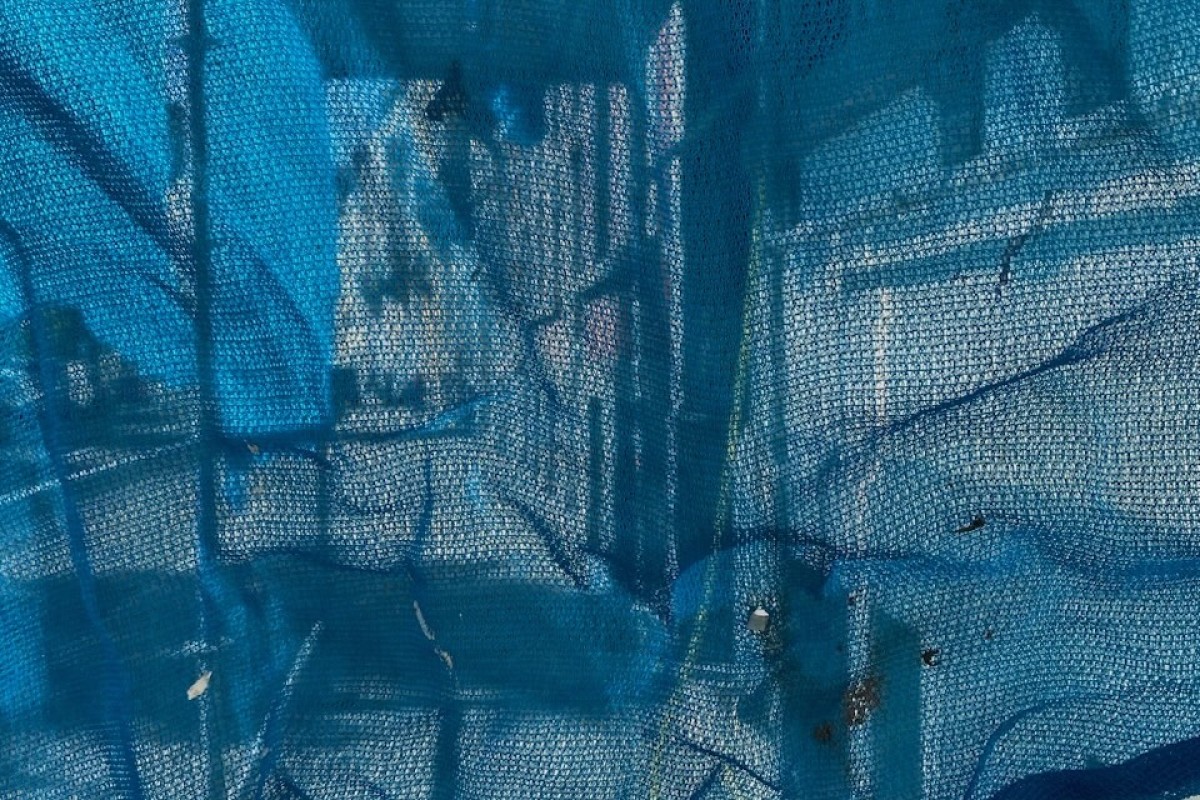
None of this would be particularly relevant were it not for a recent realization I had in the studio: my sculptures seem to have taken a decidedly churchward turn. The muted colours, the silky, velvety materials, their diptych-like / tabernacle-like appearance, the way silk chiffon conceals and highlights certain parts—none of this is something I strived for. It simply became, and I observed it. I say this as if I have no say in the matter, when in fact I am the author of these pieces.
I am interested in spaces and their inhabitant furniture as silent witnesses to the fact that spaces are never neutral. They reflect and reproduce social norms shaped by inherited ideas of gender, power, and intimacy—prescribed by the church and rehearsed in the home. I think of architecture and furniture as material expressions of heteronormative, patriarchal power structures and the ideal of the nuclear family, where gendered roles are expected to be performed. They appear at once claustrophobic and petit bourgeois. I see them as environments in which traces of behaviour accumulate over time—care, constraint, closeness, and violence settling into their forms and surfaces. Very Freudian, very Viennese of me, as Yves pointed out last night. (1)
I collect leftovers of the city and the flea markets on my way to the studio, scarves of questionable taste and small metal trinkets that might want a second life in the studio where they become my palette, sorted by colour and ready to be taken up. Next to them, I keep printed reproductions of paintings pinned to my studio window. Two of them are Vermeer’s Girl with the Red Hat and Girl with a Flute. In 2013, art historian Benjamin Binstock controversially re-attributed them as self-portraits of Maria Vermeer, daughter and apprentice to her more famous father. (2) In these images she appears intensely self-observant: painting herself, the flute reimagined as a brush, her clothes and muted tapestry rendered with exacting attention. In her father’s Girl with a Pearl Earring, she is seen; in these works, she is looking.
Once her gaze loosens its grip, I let the sculptures carry me to where they want to go. I am part of the process, but the materials have an equal say. We are in it together, negotiating the dignity of existence. It is a relationship that could be hierarchical—doctor and patient—but is not in my practice.Without the patient there is no doctor. My patients rarely bend to my will; they make suggestions, and I follow many of them. It is a process of listening, adjusting, testing, stepping back, looking again, checking for errors before closing them up again. They often surprise me. At times they become overtly sexual, opening themselves like a lover; at other times they are timid, concealing their more unstable patterns behind layers of surface and veil. A simple shift—such as freezing the motion of opening a cabinet door or a diptych—can turn into a book-like structure. A keyhole becomes a lock. A zipper begins to function like a locket. As I assemble my sculptures—Frankenstein-ing little monsters through careful acts of assemblage—I sometimes feel her gaze behind me: critical, alert, watching the work come into being.
Michaela Schweighofer was born in 1983 in Graz, Austria. Before studying art at the Academy of Fine Arts Vienna and the HFBK Hamburg, she studied English literature, philosophy, and psychology. Recent solo exhibitions have taken place at the WIELS Project Space Affiliate (2024); Komplot, Brussels (2023); Forum Stadtpark, Graz (2021); and foundation, Vienna, in collaboration with Stefano Faoro (2020). Her works have also been presented, among others, at Clages, Cologne (2025); flats, Brussels (2023); Neue Galerie, Graz (2023); SB34 Clovis, Brussels (2022); Kunstverein Eisenstadt (2021); Vienna Contemporary, Vienna (2020); and Pogo Bar at KW Institute for Contemporary Art, Berlin (2019). Currently she shows works at the Kölnische Kunstverein (DE) and at Martins&Montero gallery in Brussels (BE). An exhibition at the Academy of Fine Arts, Vienna, is scheduled for September 2026.
(1) Freud derives the uncanny (das Unheimliche) from the German ‘heimlich’, meaning both ‘homely’ and ‘secret’, suggesting that the uncanny is not the opposite of the familiar, but its hidden double.
(2) Benjamin Binstock, Vermeer’s Family Secrets: Genius, Discovery, and the Unknown Apprentice, Routledge, 2013.
- Through
- 07 August 2026
- Venue
- Loggia
- Address
- Untere Augartenstr. 26/Top 27
1020 Vienna
- Hours
- Open by appointment