

 Back
Back
‘L’invincibile Jean’ and Early Works 1956 – 1957
Artists
Piero Manzoni
Press release
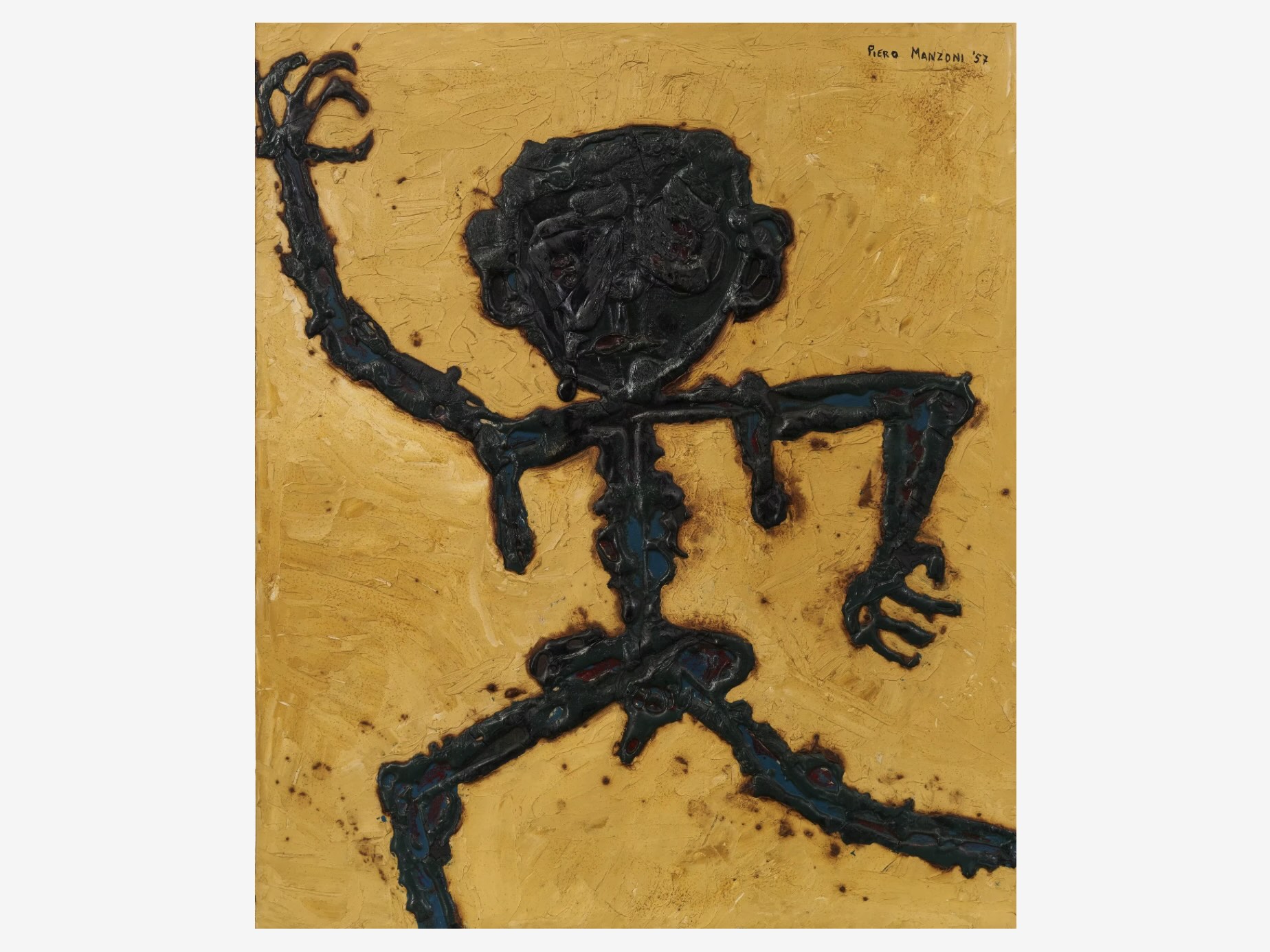
This November, ‘Piero Manzoni. ‘L’invincibile Jean’ and Early Works 1956 – 1957,’ an exhibition curated by Rosalia Pasqualino di Marineo and conceived in close collaboration with the Fondazione Piero Manzoni in Milan, is presented in our Basel gallery. A leading figure of the 1950s Italian avant-garde, Piero Manzoni (1933 – 1963) had a profound impact on the course of twentieth-century art during his brief yet prolific career, directly influencing the development of Arte Povera while paving the way for conceptual, body and performance art.
In this exhibition, the artist’s early works on view together for the first time, offering a rare opportunity to explore this formative phase of Manzoni’s practice, revealing the unexpected foundations on which his later artistic production—including his widely celebrated series of white Achromes—was built. The exhibition is accompanied by a new publication edited by Rosalia Pasqualino di Marineo and published in collaboration by Fondazione Piero Manzoni, Hauser & Wirth and Silvana Editoriale. it is the first publication exclusively dedicated to this early and formative phase of Manzoni’s practice and includes an essay by scholar and curator Choghakate Kazarian.
Born in Lombardy in 1933, Manzoni began his career as an artist in 1956. He would go on to produce a rich and innovative body of work before his career was cut short just seven years later by his sudden death from a heart attack at the age of 29. A self-taught painter, Manzoni exhibited his work for the first time as part of the Mostra d’Arte Contemporanea in 1956, organized at the Castello Sforzesco of Soncino on the occasion of the local market fair, where he presented two works, including ‘Domani chi sa (Tomorrow who knows)’ (1956). On view in Basel, this work reveals the extraordinary inventiveness of Manzoni’s approach from the very beginning, with the painting created by stamping keys dipped in paint over a dynamic, gestural abstract background. Manzoni’s lack of formal education in the fine arts left him free to develop an entirely original artistic identity, unencumbered by received ideas or accepted conventions. Immersing himself in the melting pot of the Milanese art scene, he encountered work by artists including Enrico Baj, Roberto Crippa, Sergio Dangelo, Gianni Dova, Ettore Sordini, and Angelo Verga. He approached his influences with irreverence, playfully combining elements of Art Informel, Surrealism, Dada and the historical avant-garde into a new pictorial language that was wholly his own.
- Through
- 14 February 2026
- Venue
- Hauser & Wirth Basel
- Address
- Luftgässlein 4
4051 Basel
- Hours
- Tue-Fri: 14:00-16:00, Sat: 11:00-16:00