
 Back
Back
the sound of everything repeating
Artists
Remi Ajani
Press release
After Many a Summer Dies the Swan
as soon as a voice goes on arguing
in its sleep like a file going to and
corrosively fro
doesn’t sound like a man sounds
more like an instrument’s voice very
small
so the thought goes on recycling
itself and the mouth opens and the
body begins to shrivel into something
more portable
which is me old unfinished not yet
gone here I go again
– Alice Oswald, ‘Tithonus: 46 Minutes in the Life of the Dawn’ (2016)
Everything is a version of something else.
– Larry, Act II: Patrick Marber, Closer (1997)
Long ago in the East, Eos, Goddess of the Dawn, fell in love with Tithonus, a Trojan prince of legendary beauty, and asked Zeus to make him immortal – forgetting to ask that he not grow old. As their love continued, Tithonus aged while Eos did not, his body withering, his squinting eyes struggling to bear her brightness, until she could no longer recognise in him the man she had loved. Unable to kill what she had made immortal, Eos turned Tithonus into a cicada so that she would hear him, even if she could no longer look at him. The poet Alice Oswald’s Tithonus gives this ancient myth a single formal constraint: within the 46 minutes in the life of the midsummer dawn, the duration between the sun sitting six degrees below the horizon and sunrise, she narrates an ancient, babbling man, old and unfinished, wretched yet unable to die, as all his thoughts recycle into an infinite loop. Remi Ajani’s present series of paintings take their title from the poem’s central phrase – the sound of everything repeating – and, I argue, its central predicament. What makes our lives have purpose is precisely that they will not last. The same is true for a moment of dawn, a gesture, a face, a love.
The myth feels newly prescient. We live now inside a media environment that has abolished the logic of the single moment: the feed refreshes before the last image has settled, notifications arrive before previous ones have been processed, and the archive makes everything simultaneously present, the decades collapsed into a single scrollable surface on which last year and thirty years ago are seen side by side, often arbitrarily spliced together and entangled to gnaw at our capacity for nostalgia and hold our attention. Time, in this condition, is experienced as an accumulation of circular repeats with each iteration uncannily changed from the last. We are all, in our way, Tithonus: unable to end what we have started, and to commit to our love, and unable to die the small necessary deaths that punctuate a life lived in sequence. Ajani’s paintings insist, in their ambivalent facture, on the value of the singular and unrecoverable moment. Tithonus suffers not because he is merely old and infirm, although old age and infirmity ails him; he suffers because he cannot end. And so, the cicada into which Eos finally transforms him is a kind of mercy because it serves as the restoration of finitude, the return of time as something that means something because it runs out. To be mortal is to be capable of loss, and it is loss – the possibility of it, the imminence of it – that lends colour to all experience.
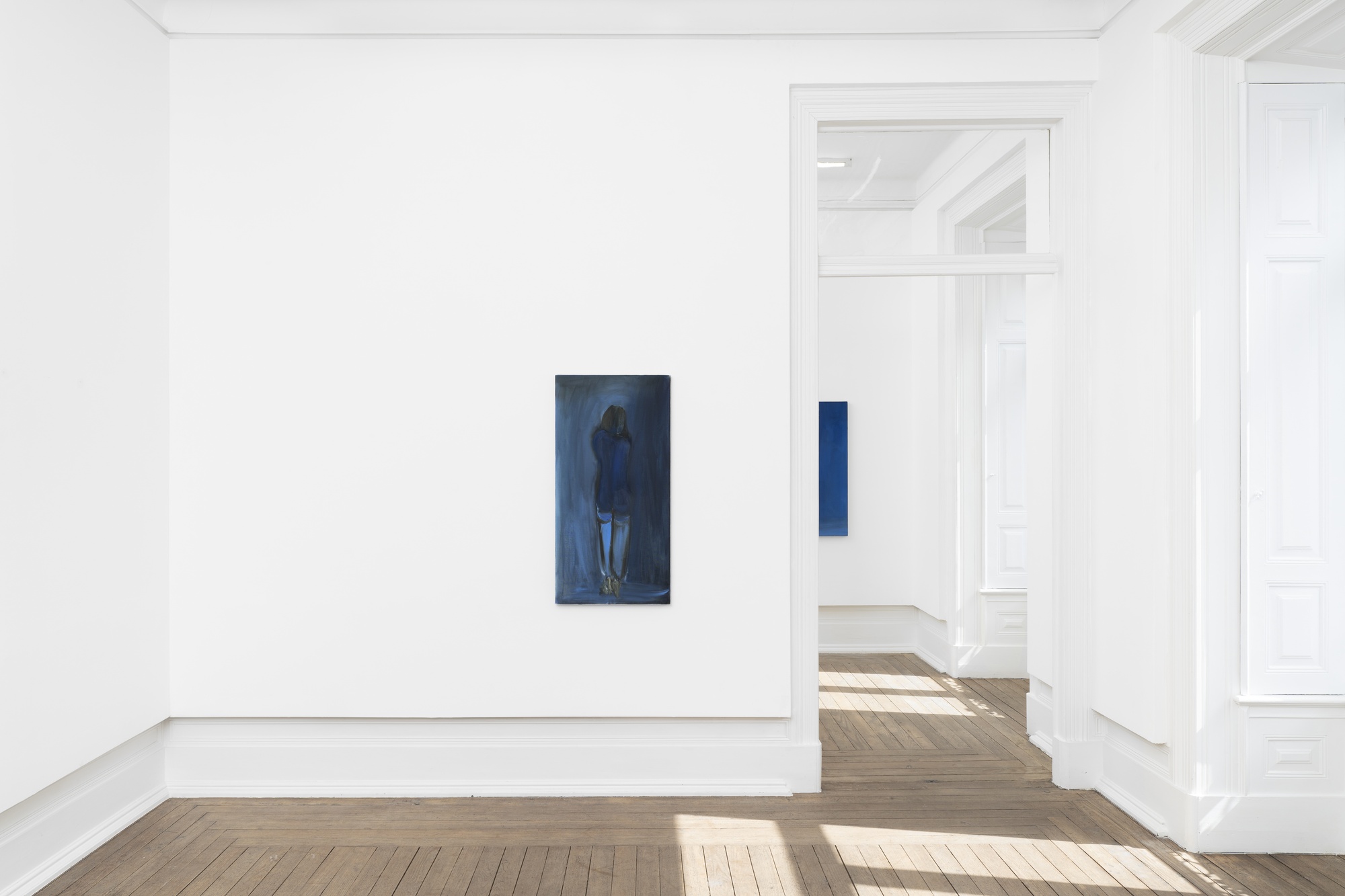
In Immortal (all works 2026), Ajani’s largest work in the series, painted on a canvas roughly the width and height of an interior door, two figures occupy the same deep blue field: the left older, the right younger; the older figure’s face severed by the edge of the composition, the younger’s seemingly fading back into a depthless shadow. Together they recall the myth’s central image: not Tithonus alone but the simultaneous depiction of the one who ages and the one who does not, arrested before the difference becomes unbearable. In the traditional format of the double portrait, Immortal forecloses the conventions of the genre and foregrounds the figures’ anonymity as well as their ambiguous relationship. In the reduced palette we find our subjects lit in a wincingly improbable artificial light, as though the camera that might have taken this source photograph had been held too long in the dark, the image underexposed, the figures emerging from the developed print incompletely and now cropped, the light that should have fixed them having arrived too late or in too little quantity to hold them fully to the surface. We see them and yet we are unable to recognise what we see. Our eyes might delight in the expressive brushwork, that beatific blue, or the delicate clasp of those skittish central fingers, but the mind remains frustrated: who are these two, and what are they posing for, and what’s missing for us? Ajani is fond of Ad Reinhardt’s claim that ‘art is art, and everything else is everything else’: if that is so, then why do we feel as though everything else (context, the world, the lives behind the image) needs to be brought to bear on the painting? I want answers and none are forthcoming. Well, art is art.
In my mind, one of the reasons why Ajani is drawn to the Tithonus myth is because its central concerns – ageing and endurance, love and its costs – illuminate something the Greeks understood that we prefer to forget: it is the impermanence of happiness, and not the prospect of its continuation, that is happiness’s necessary condition. For those of us presently happy or in love, we seek the furtherance of that condition indefinitely; the myth reminds us that such furtherance, granted, becomes its own punishment. Seen in this light, Immortal stages the impulse behind the family photograph and behind the painting of such a photograph: the attempt to fix a moment for posterity that confirms, in the very act of fixing, that the moment is already irrecoverable. The image is evidence that what it shows is already gone, held now only in the dark of paint and memory, underexposed, incompletely fastened, and perhaps precisely for that reason, still alive to us.
For several years, Ajani has depicted dancers at the extreme edge of performance: impersonal figures, bodies contorted and often upside-down, holding strenuous positions without any suggestion that this is entertainment for an audience. In Stygian (2026), one such figure steadies themselves on a pole at the centre of the composition: at the top of the pole, sumptuous white shoes; at the lowest edge, the unmistakable grip of a hand, though a ghostly shadow above and to the left reveals the trace of pentimento and marks where an arm was once painted and revised away. What remains of the arm, ghostly in its erasure, stands as the artist’s revision made visible, the record of a decision to let something go. Stygian: of or relating to the Styx, the river of the underworld, from which we inherit the word’s broader sense of something extremely dark and forbidding. Is the figure on the pole then not crossing over – from vertical to horizontal, from upright to inverted, from effort to surrender, as their precarious hold on the living world awaits another inversion in this darkened field of action?
Sisyphus, meanwhile, is a small, near-square canvas working in a field of deep reddish-brown – a warmer, earthier ground than the deep blues that dominate much of these works. Against that ground, a figure emerges in a sickly olive-yellow, crouching or braced, the body bent under its own weight, as though caught at the moment the boulder has begun its descent and the whole terrible cycle recommences. The paint is dense and low contrast, the form barely distinguishing itself from the field around it, so the labour of looking mirrors something of the labour the title names. The title invokes the figure from Greek myth condemned by the gods to roll a boulder up a hill for eternity, only to watch it roll back down: the punishment consisting not in the labour itself but in its perpetual incompletion. Sisyphus’ work will never be completed and there will be no promise of rest once the task has been completed; his lot is pure endurance, and Oswald’s words on Tithonus’ thoughts could just as plausibly be Sisyphus’ muttered ramblings to himself as he descends once more: ‘old unfinished not yet / gone here I go again.’ Albert Camus, who made Sisyphus the central figure of his essay on the Absurd, wrote that ‘for the absurd man it is not a matter of explaining and solving, but of experiencing and describing. Everything begins with lucid indifference.’ That indifference or, more accurately, ambivalence, the hallmark of great painting, is everywhere on Ajani’s surfaces: the reddish-brown field does not mourn the figure within it, and the figure does not appeal to the field for relief. Camus again: ‘each atom of that stone, each mineral flake of that night-filled mountain, in itself forms a world.’ In Sisyphus’ world, the stone is the stone, and everything else is the stone.
Ajani’s commitment to recurrent forms and to series operates both between individual works and within individual works. Take, for instance, Echo, a wide horizontal canvas on which the same form appears three times across a warm brown ground. Each is a dark, near-spherical bloom of a ranunculi flower on a green stem, the bulbous heads heavy and closed, a small blush of pale pink at the crown where the petals have not yet opened. They are nearly identical and are yet discernibly different: the spacing slightly irregular, the paint handling shifting subtly from one to the next, as though each is placed in iterative sequence that carries some kind of the trace of its own making. The title names the echo as the same sound returned at a slight remove, altered by the distance it has travelled, but also speaks to the nymph deprived of speech by Hera to stop her chatter, and left able only to repeat what others had said. I have spoken before about the ways that Ajani’s flowers speak to Cy Twombly’s hedonistic erotic flora of gesture and spillage and how, so many centuries after the still life genre began to stage the passing of life in the midst of death, a new generation of artists have taken up this subject. Arthur Jafa has spoken of Black cultural production as a practice in which repetition is a mode of survival rather than a symptom of exhaustion — the sample, the cover, the remix extending and complicating what came before rather than diminishing it. Echo works in that spirit. Each bloom is painted knowing the last one was just painted, and the hand returns to the form anyway, finding in the return something the first pass could not locate.
Ajani’s paintings know what Tithonus forgot to ask for: not more time, but the right kind. Each canvas holds its figure at the threshold, whether crossing over, bending under, or fading back, and holds just long enough for us to feel the imminence of what is about to be lost. Everything repeats, and Ajani keeps painting; the sound of everything repeating is also, it turns out, the sound of someone still here.
Text by Matthew Holman
- Through
- 01 August 2026
- Venue
- Jahn und Jahn
- Address
- Rua de São Bernardo 15 R/C
1200-823 Lisbon
- Hours
- Wed–Sat 12–7pm and by appointment