

 Back
Back
Gluts
Artists
Robert Rauschenberg
Press release
Overview
Objects + materials occupy real space, very much the way ideas have elbows.
— Robert Rauschenberg
Thaddaeus Ropac Paris Marais presents the first exhibition in 15 years dedicated to Robert Rauschenberg’s sculptural Glut series (1986–94), and the first exhibition of the series ever held in France. In the year of the centenary of the American artist’s birth, Gluts runs in parallel to an extensive programme of exhibitions in Rauschenberg’s honour taking place at museums and institutions around the world.
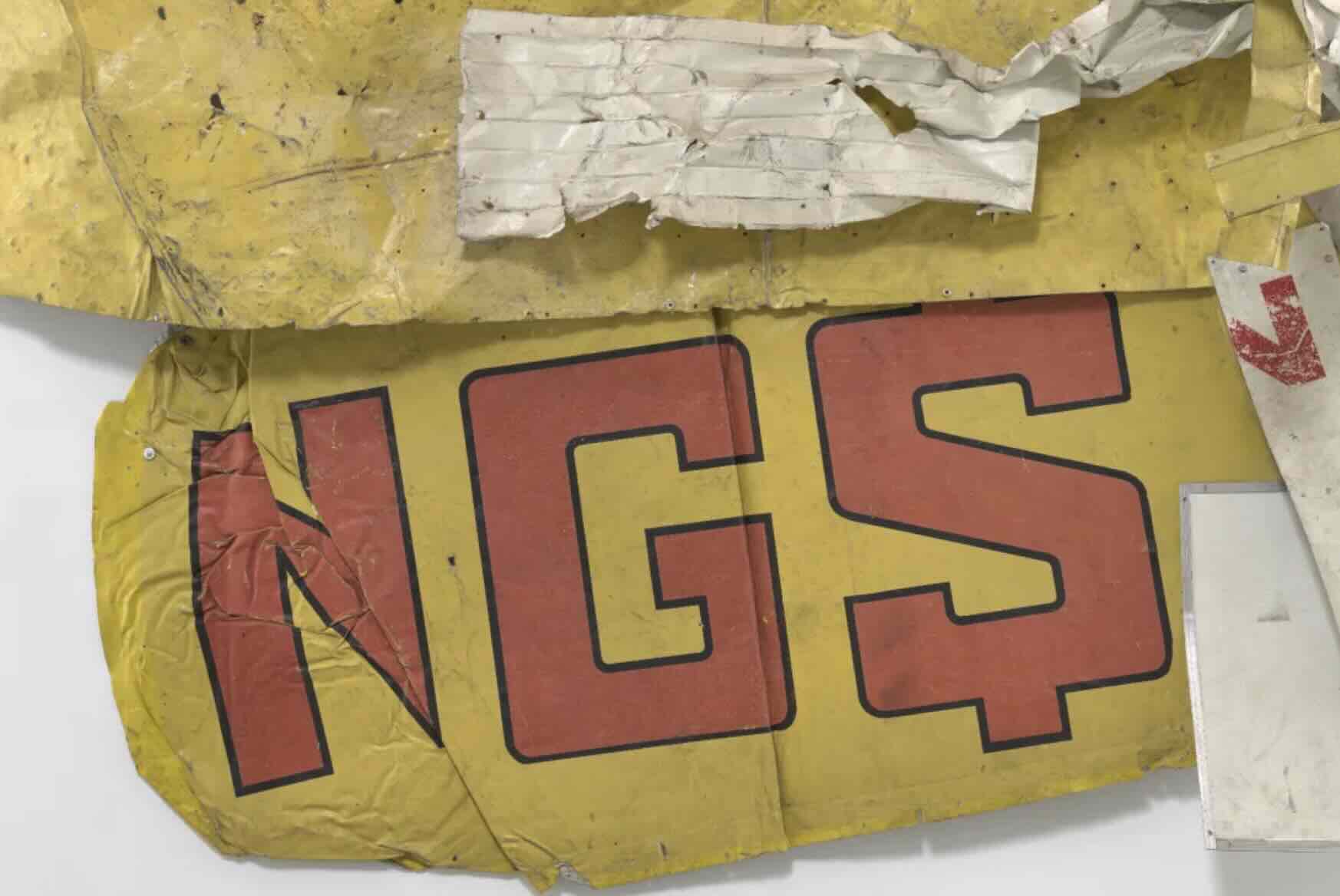
Beginning with his early Combines (1954–64), Robert Rauschenberg (1925–2008) revolutionised the picture plane through the inclusion of everyday objects, which he termed ‘gifts from the street’, redefining and expanding the boundaries of what could be considered an artwork. It was in this spirit that he created his Glut series of sculptural assemblages at the end of the 1980s and the beginning of the 1990s. They represent one of his earliest forays into a new material – metal – in the form of found objects assembled and riveted together to create wall reliefs and freestanding sculptures. Unlike in the artist’s earlier Combines, however, the found elements in the Gluts are no longer affixed to canvas supports. Instead, they become entirely autonomous, placed directly on the wall or the ground in a wholehearted engagement with the poetics of recycling and reclamation.
The Gluts would be the artist’s final series of sculptures, as well as his most enduring: the usually restless Rauschenberg continued returning to the series over the span of almost a decade. The Gluts are rarely seen together, with the last exhibition dedicated to them held in 2009–10 at the Peggy Guggenheim Collection, Venice; the Museum Tinguely, Basel; and the Guggenheim Museum, Bilbao. The series was inspired by the artist’s visit to Texas in 1985 for his exhibition at the Contemporary Arts Museum, Houston. At the time, Rauschenberg’s native Texas was in the midst of a recession due to a surplus, or ‘glut’, in the oil market, turning its landscape into a wasteland of abandoned vehicles and the rusting signs of failed petrol stations. Returning to his studio in Captiva Island, Florida, Rauschenberg, marked by what he had seen in Texas, sought out similar objects in the local scrapyard, salvaging discarded signs and automotive and industrial parts to create the first Gluts: a gesture that anticipated the environmental concerns that, decades later, have taken a central position in artistic thought and production.
Rauschenberg's work throughout the decades embodied his lifelong commitment to collaboration with performers, artists and engineers. As well as choreographing his own performances, he designed lighting, sets and costumes for avant-garde productions by Merce Cunningham, Trisha Brown and Paul Taylor, among others. In 1987, when the set for a performance of Trisha Brown Dance Company’s Lateral Pass (1985) in Naples, Italy was stuck in a dock strike and would not make it to the theatre by opening night, Rauschenberg scoured the streets and scrap heaps of Naples to collect materials to make a replacement set. As Brown recalled: ‘Bob and his team dumped a truckload of junk backstage and proceeded to sort, stack, drill, and grommet into the night.’ He later incorporated pieces from this stage set into the Glut series, referring to them as the Neapolitan Gluts. The exhibition at Thaddaeus Ropac Paris Marais presents several examples of the Neapolitan Glut series alongside the Gluts made in Captiva Island.
In some Gluts, the source objects are easily distinguishable through identifying markings, in particular painted lettering: truncated business signs; instructions on industrial pieces; road signs. Summer Glut Fence (1987) notably retains two faded but legible stop signs. As curator and art historian Susan Davidson wrote in the catalogue accompanying the exhibition of the Gluts at the Peggy Guggenheim Collection in 2009: ‘Directionals have been a visual trope in Rauschenberg’s work as he sought to directly engage the viewer by speaking in the imperatives of the everyday landscape’. Such ‘directionals’ are found across his works; the stop sign, in particular, appears in another Glut, Stop Side Early Winter Glut (1987), in the collection of The Museum of Modern Art, New York. But Rauschenberg chose and assembled the Gluts not only based on the symbolic significance of their components or the semiotic possibilities of their combination, but also for their formal properties, dissimulating and distilling his source objects into ‘lean expressions’ of a refined lyricism that belies their scrapyard origins.
The Gluts, Davidson adds, represent ‘an extremely mature and confident body of work, personal exercises or amusements for Rauschenberg, where the whole becomes more than the sum of its parts.’ At first glance the viewer finds elegant formal abstraction; with a second look, what Mark Alizart calls ‘the appearance of function’ in his essay in the catalogue accompanying the exhibition. In Balcone Glut (Neapolitan) (1987), a ladder projects through the opening in a ventilation duct to imply the titular ‘balcony’; the interconnected wheel in Tropical Mill Glut (1989) suggests the titular device. But more than this, there is a sense of anthropomorphism across the Gluts, where the coldest, hardest of materials is animated with details that play on our pareidolia to suggest dangling legs or eyes. These futuristic constructions made from the detritus of a society in which industrialisation has begun to eat itself alive, unexpectedly, call for ‘a more human world, not less’; ‘ultimately’, as Alizart continues, ‘the logical consequence of a philosophy that associates art and life’.
The exhibition will be accompanied by a catalogue including archival photography relating to the Gluts, as well as an essay by philosopher Mark Alizart and an excerpt of choreographer Trisha Brown’s account of the creation of the Neapolitan Gluts.
Robert Rauschenberg: Gluts is presented in cooperation with the Robert Rauschenberg Foundation. Thaddaeus Ropac gallery has been a partner of the Robert Rauschenberg Foundation since April 2015 and the partnership has resulted in a series of exhibitions, focusing on some of the artist’s most innovative and under-recognised series of the 1970s, 1980s and early 1990s, including his Spreads (1975–83), Salvage paintings (1983–85), Borealis (1989), Night Shades (1991) and Phantoms (1991). For further information on the mission and programmes of the Foundation, visit www.rauschenbergfoundation.org. (This link opens in a new tab). and follow them on Instagram at @rauschenbergfoundation.
100 years of Robert Rauschenberg
Gluts at Thaddaeus Ropac Paris Marais opens 100 years – almost to the day – after Robert Rauschenberg’s birth on 22 October 1925. In celebration of his centenary, a wide-ranging programme of exhibitions dedicated to the artist is taking place in 2025–26. Gluts will run concurrently with exhibitions at the Museum Ludwig, Cologne (until 11 January 2026); Fundación Juan March, Madrid (until 18 January 2026); The Menil Collection, Houston (until 1 March 2026); The Guggenheim, New York (until 5 April 2026); and Museum of the City of New York (until 19 April 2026), as well as an exhibition dedicated to Rauschenberg’s collaboration with Trisha Brown on the 1979 dance piece Glacial Decoy at Walker Art Center, Minneapolis (until 24 May 2026). These will be followed by further exhibitions at M+ Hong Kong (opening November 2025) and Kunsthalle Krems (opening April 2026). Organised by the Robert Rauschenberg Foundation, the programme of exhibitions, which is accompanied by dozens of Centennial grants encouraging the activation of Rauschenberg's works in public collections, aims to build on the artist’s legacy of promoting cross-disciplinary explorations and driving social change.
- Through
- 22 November 2025
- Venue
- Thaddaeus Ropac (Marais)
- Address
- 7 Rue Debelleyme
75003 Paris
- Hours
- Tue-Sat: 10:00-19:00