

 Back
Back
Meta-Guilt
Artists
Salomé Chatriot
Press release
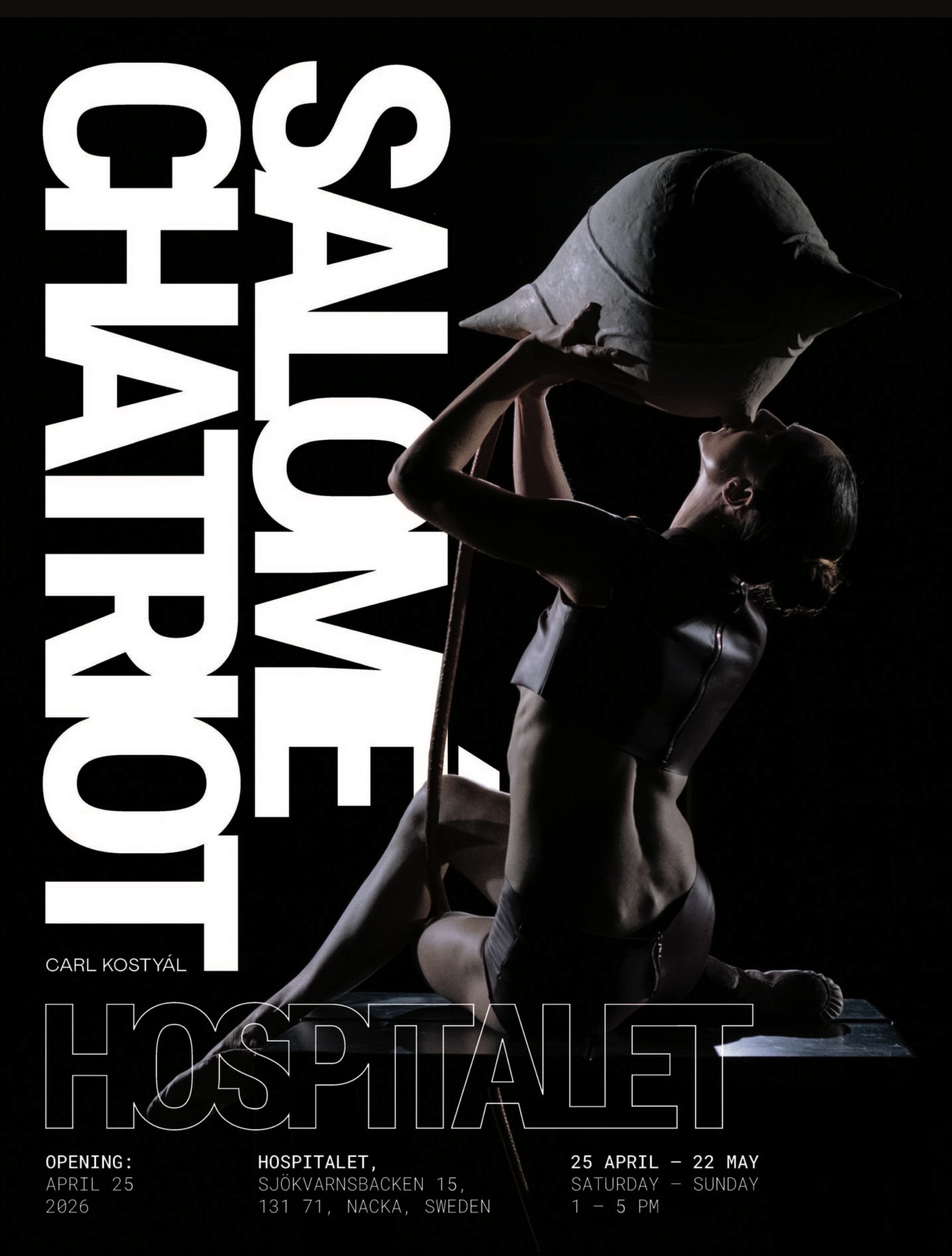
Carl Kostyál is delighted to present the debut exhibition of Salomé Chatriot (b. 1995, Paris) in Sweden – ’Meta Guilt’ at Hospitalet, Stockholm. Chatriot had her first exhibition ‘La Victoire d’Arlequin’ with Carl Kostyál in London (2025) and has participated in the gallery’s Invitational Draw Jam in 2022, 2024 and 2025.
“Salomé Chatriot’s exhibition is a keystone. A contorted, gravity-defying, logic-bending one, but a keystone, nonetheless. As one enters Carl Kostyál’s Stockholm location, one is faced with a structure about to bloom under its vaulted ceiling. ‘Meta-guilt’ features an ensemble of recent works stemming from two of the French artist’s main series which are now set to enter their final, crepuscular iteration. The first of those, ‘Fetish Goddesses’, presents iridescent truncated torsos rendered in enamel paint on an aluminium background left bare. The second, ‘Idols’, shows arched figures rendered in the same technique yet heightens its symphonic effect through a painted backdrop of light rays and billowy skies.
At Hospitalet, both series are shown together in a dense procession of prosthetic goddesses.[1] We seek to identify a known form: a nude, female-presenting human body. This is what centuries of canonical, Western art history has taught us. Spontaneously, we start to elaborate upon ‘serpent-bound earthly bod[ies]’[2] where ‘the flesh is wonderfully alive and beautiful’.[3] We must unlearn all such reflexes as Salomé Chatriot’s starting point is not representation but generation. The 1995-born artist has grounded her recent work in the most vital, violent—and arguably, sacred— of all life fluxes: the breath, her breath, carefully recorded during her publicly staged performances. She has then transformed the collected data into graphic shaders, namely specific computer programs which execute operations needed to ultimately render an image. No entity pre-exists, as the slippery illusion of totality arises through perspectival camera tricks.
In « Nomadic Subjects » (1994), philosopher Rosi Braidotti reflects upon the evolution of the socially constructed body. She starts with Michel Foucault’s assertion that, since the eighteenth century, it has been at the heart of techniques of control to make the subject productive and reproductive. Of her own era, which follows another long chain of postmodern fragmentation and biotechnical manipulation, she asserts: ‘The bodily surface, and the complex montage of organs that compose it, is thus reduced to pure surface, exteriority without depth, a movable theater of the self.’[4] After what Braidotti names ‘organs without bodies’, now come Chatriot’s quantified organs with an infinity of possible databodies.
However, there is a twist. The artist’s research, conducted for most of the past decade, has matured in parallel with the rise of the quantified self and generative AI. As we have now grown intimately accustomed to such phenomena, we are also able to grasp how Chatriot responds and pushes against both. Neither capitalist optimization, cultural biases, nor knowledge extractivism is implicated here, as she endlessly self-exploits and auto-standardizes in stubborn dialogue with her cyclopean, “celibate machines.”[5] What is offered to our eternally scopic drive is nothing other than a looped, solipsistic shiny-too-shiny system through which to reflect on wider, societal issues by first understanding a smaller, subjective model. It is reverse-engineering made flamboyant, aiming at the transparency advocated by the emerging practice of data-feminism.”[6]
– Ingrid Luquet-Gad
[1] The term was coined by Hal Foster. See Foster Hal, Prosthetic Gods, Cambridge, Mass. : MIT Press, 2004, 455 p.
[2] This quote, and the one after, both relate to descriptions of the marble sculpture Laocoon and his sons, copy after a Hellenistic original from ca. 200 BC, Museo Pio Clementino, Vatican Museums Italy. Herder Johann Gottfried, Sämtliche Werke, XXIX, 303f.
[3] Winckelmann Johann Joachim, Sämtliche Werke, Donaueschingen: Verlag Deutscher Klassiker, 1825–29, I, 239f.
[4] Braidotti Rosi, Nomadic Subjects: Embodiment and Sexual Difference in Contemporary Feminist Theory, New York, NY : Columbia Univ. Press, 1994, p. 50.
[5] The term is used to name artist Marcel Duchamp’s bottom half of La Mariée mise à nu par ses célibataires (Le Grand Verre), 1915-1923. For the motif’s posterity as a « modern myth », see Carrouges Michel, Les machines célibataires, Paris : Chêne, 1976, 183 p.
[6] D’Ignazio Catherine and Klein Lauren F., Data Feminism, Cambridge: The MIT Press, 2020, 328 p.
- Through
- 24 May 2026
- Venue
- Carl Kostyál
- Address
- Hospitalet, Sjökvarnsbacken 15
13171 Stockholm
- Hours
- Saturday – Sunday 1 – 5 pm