
 Back
Back
Difference
Artists
Sanna Helena Berger
Press release
und zwar (Lack) Sanna Helena Berger
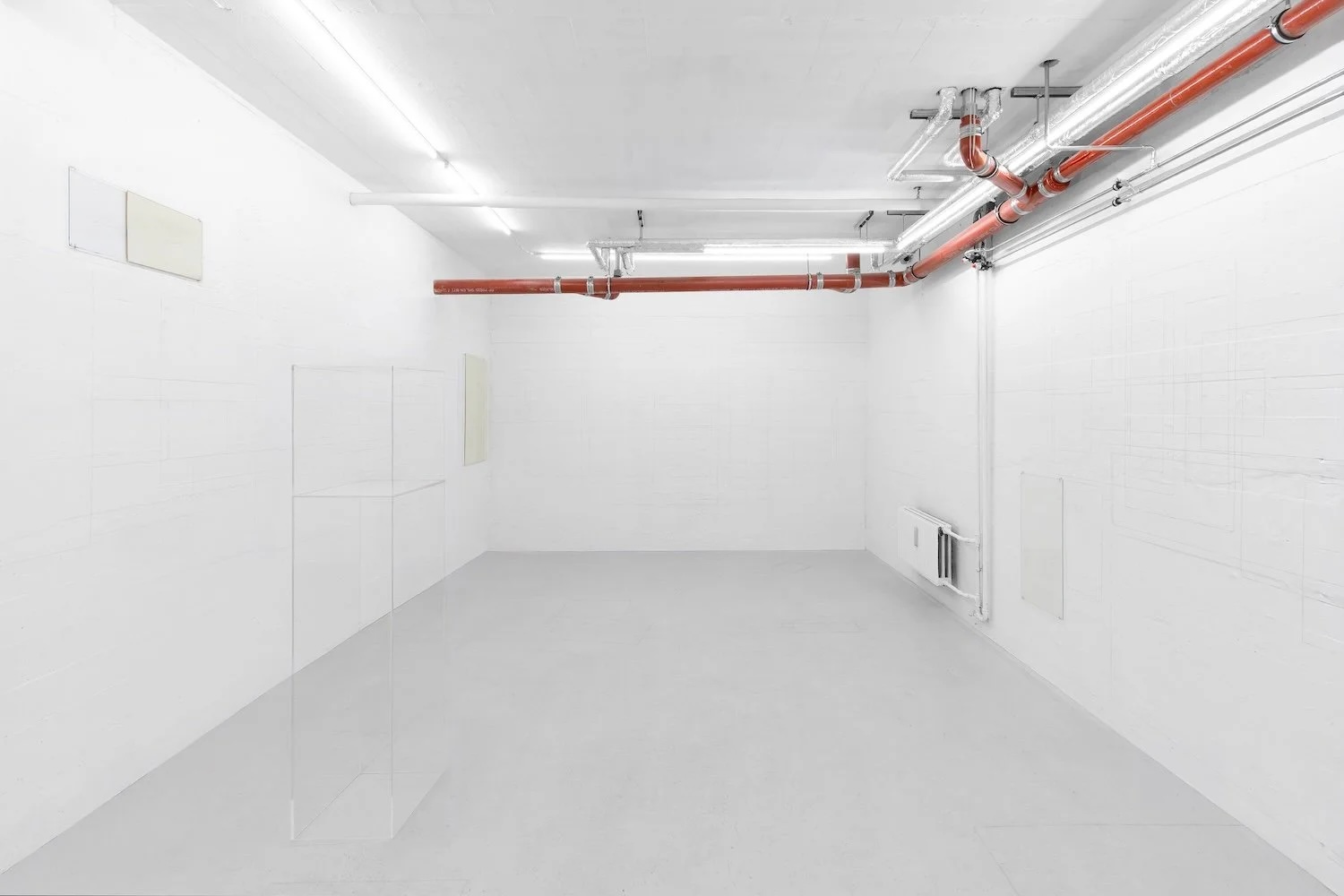
I am asked how I would translate “und zwar”. I answer that I wouldn’t, I suppose, and I suppose it is a rather antagonistic answer to the question, but in choosing this title I deliberately accentuate its equivocacy. When we think of deixis, if we do ever think of deixis, at least formally, we assume it points to something which will relieve it from this ambiguity, another something will step in, to explain its motive for being. But without this motive, without that which the deictic expression is pointing to, we’re left with a part.
Deixis originates from the Greek deıknúnaı which means to show. But this seems paradoxical to me, because it is exactly what we do not do, in deictical syntax. In my view, at least, it is the pointing towards, which is done, and so it rather abdicates the showing, to the heir, namely its meaning. A meaning that is proclaimed only by what issaid—if absent, this unsaid lacks the entire reason for its being. So at least in my logic, it is entirely dependent on that which it points to—to show itself. The deictic index finger, so to say, shows itself only as a pointing dependent, contextually pregnant, but when plucked out of this context—rendered mute in meaning, only when that which it points to is revealed, so too is its meaning, but it still does not remove the finger.
Utilising or maybe negotiating deixis into pointing towards a space, instead of a word, a space which is contained but shows ‘nothing’, might be a particularly idiosyncratic idiolect of mine, or it might simply be incorrect, as far as convention goes. But as a hypothesis, it does not need to legitimise itself through facts; it is itself a kind of pointing to. My argument is that a space that can be both liminal and contained, a space which lacks motif can still be framed.
Removal is one thing. When we have removal, we first have the something which is subsequently removed, but there is also the act of removal; the taking away performs the remaining nothing. But when something is removed, there is not always a noticeable absence, the presence of absence is not always a given when the something goes.
When my daughter is away I take the opportunity to remove things from her room which were once active, but now seem to exist only passively by occupying space. This is an impossible act of clearance in her presence. She will immediately interject any kind of decluttering of passive things, objects in lieu. Often these are not even things proper but little scraps and residue; proverbial fluff. Sometimes I have the feeling that even the dust that the stagnant matter collects can be precious to her. Without fail, whatever I pick up to throw out—a snippet of an old serpentine party favour, a chestnut, a coin, which on its own is literally worthless and becomes transactionable only when compounding with others is, to her—priceless. As soon as the item in question is about to be removed it regains total worth to her, possibly a higher worth than when she first collected this nut, this coin, this pamphlet for collective farming in Brandenburg.
With the threat of discardment, this detritus becomes resplendent, the ne plus ultra of iotas. In this case its removal is the apotheosis of the thing’s existence, otherwise discarded unceremoniously because it is the kind of thing you happened upon in the bottom of a coat pocket, a thing which seems to exist only to expire. In her presence it is a ceremonious demonstration of objection to expiration. But thankfully, when she’s away, I can strategically discard at will. No requiem sounds for bits and bobs, odds and ends and bric-a-brac knick-knacks, no protest hinders their quietus by way of black binbag.
The child’s lament over collected stuff, once removed, is too anecdotal to say much about lack at all. But the fact that the prospect alone of lacking something, which had come to mean barely anything, can be more powerful than that something was in the first place, says (rather poetically) a lot about the potency of removal, as a conduit for lack. The act of pointing to the erasure is the actual puissance here, not the removal itself. When the thing is gone, we might not even notice its absence; but to witness its potential forfeiture without intervening evokes our loss of the thing through our neglect of the matter.
Habits create lived-in hues. An aging complexion of the face takes on age akin to the weathering complexion of our habitat, a mundane and prosaic causation. Holes, marks and discolourations become evidence, proof and indication of a life lived. These seem more or less inconsequential when we live with our things, matter and material but when things are removed they gain a new presence in their lacking; we experience the traces, outlines, bruises caused by their existence through their now underlined absence. Just as when we look at a picture of ourselves fifteen years ago, the process becomes clear, but day-to-day, we see the change, not at all.
Ivory, cream, pearl, alabaster, porcelain, bone, cotton, salt, chiffon all embody an ambience of white but shift in hues when placed in stark contrast to a pure white—an absolute white. And rarely is anything in life a pure white; printing paper, salt, snow, flour, toothpaste, maybe some chalky cheeses, but only ever in very rare cases. Most other things we think of as white are, in fact, not white. This becomes clear when removing something from a shelf which has stood there, stagnant, perhaps in the half-sun, books, be they some kind of encyclopedia, lingering on, reduced to decoration, symbols of pathos, rather than as a diligently counseled lexicon, and makes you realise that your white shelf has turned a patina of beige. But only now, through the absence of the pathos, can you differentiate between what you thought of as white and that which is not white. Your relation to this fact is only disputed because of that which is lacking.
These residual proofs of life become rarer and rarer, these non-aggressive defacements are erased, themselves, through contemporary living. We move too often, we keep too clean, we minimize. Whoever reappropriated the concept of minimalism to mean owning less things should get a schooling, but also nestled in there is a deep disdain for collecting, collecting matter, which, as much as a half rotten nut can mean to a six year old, can become absolute in your value of living.
In a trainspotting kind of charm the things that you own can end up owning you but this is a vastly different philosophy to beige, beige, beige.
Taken entirely out of context, which is often a fun way to relate to knowledge, and especially those aspects of knowledge which have been hinted at and turned into a reification, something once half-baked is pressured into exgenesis, a metaphor hardens into ontology. I hear this done over and over again as I drift off to sleep, when it seems impossible, by the help of “listening” to middle aged white males (I won’t mention the fetischistic aspects of me being a high-school drop out) drawly and dryly discuss their usual suspect heroes; Freud, Lacan, Wittgenstein, Zzzz. The canonisation of whom far surpasses the mere existence of men. Lacan for example, mentions some of his now best known “ideas” less than a handful of times, and yet the absence of Lacan himself to repudiate the canonisation of these very same, barely mentioned, en passant ideas, creates a possibility for these, at times puns in jest, to become positively doctrine, instead of, well, funny.
The absence of the clarity around the thing itself has become paraphrased as the thing itself. (I try not to make a ‘das Ding’ pun here, but, like Lacan, I have an affinity for basic humour when I’m orating.) Anyway, taken out of context, and thus not so much critiquing the fallacy of misplaced concreteness—simply just not focusing all that much on being right, I like to think of objects through a Disney-fied object-oriented philosophy, because, in truth, it is really the only way I can understand it. And even though this should be more of a note in the margins at this point, as Harman clarifies, and I paraphrase that we should refer to this “philosophy” as ontology, since calling it a philosophy was something he simply, at some point, said in jest: a joke turned aphorism. And when trying to understand his objection to the post-Kantian objection to the thinkability of noumena, in which Harman and alike go on to say that objects exist independently of human perception and are not ontologically exhausted by their relations with humans or other objects, I turn to Disney.
I think of Beauty and the Beast, Lumière the speaking candelabra, the fat clock and the operatic wardrobe, and the small teacup with a chip, called Chip, and is that his grandmother or his geriatric mother? (And if it is his grandmother, is the chip a sign of unspoken trauma from losing his mother, off screen?) All of which attempt to, as if by sheer will, apply itself to my understanding of object-orientated-ontology as I read about it.
“… the withdrawal of objects from human perception into a reality that cannot be manifested by practical or theoretical action”. Dancing teacups! Millions of dancing teacups cascading down a Putin-esque dining table in a majestic ballroom, flanked by singing curtains! “Objects are unknowable outside of the imposed categories of the human mind, in turn, shores up discourses wherein objects frequently become effectively reduced to mere products of human cognition”. The candle-stick-man opening the clock-man’s glass door to stick his candle-stick-hand in, to wind the clock-man’s hands out of time, so so tight, inside of the clock-man’s would-be stomach.
I think of other animations, stories and illustrations which are not Disney per se but adhere to the pervasive Disneyfication of life. The fact that Kant himself seems to both deny and rely on the noumenon as an idea, reads as yet another joke that neatly aligns with the niche humour about facts becoming philosophically over-theorised. Perhaps “alternative facts” is our generation’s
most applicable philosophy, easier to remember, than, say, “optional refinement” or “retroactive foundationalisation” or “conceptual hypertrophy”, two of which I made up.
All this to say, I have no idea what I was trying to say… but something about objects.
Life in times of popularised minimalism, health and outdoor obsessions limit the smirch of life itself, and with less grime, there’s less trace within it. And lacking seems to have become a virtue rather than a deficit.
Removing something but letting the remnant of the something leave a trace begs the question, if this evidence points only to what was, or whether it can become without being determined as an echo. Can a vestige become autonomous of its genesis?
If we turn the frame around, showing nothing but its construction, if we hide its motif, does it become without motif or simply a new pictorial space, even when lacking its tradition? Despite having no box, a Schrödinger’s-cat-like painting might be alive and dead on its reverse, so is this potential of the motif, the new motif? If we don’t even have the frame, if we don’t have the proof of that which has left the trace, can we apply the same kind of dead-and-alive value within the outline of something that once was?
A painting of awe and adulation could have had the exact same measurements of an 83-inch flatscreen TV. Then, if the something which creates the vestige can be disembodied from an absolute value and exist itself only as cultural mnemonic, our own subjective references will fill in the blank and express a motif of potential ghostly objects. Is it then—and maybe this is what I wanted to come to earlier—possible that this is a kind of thing-in-itself? If the object of inquiry is no longer anything but its outline, can we not let this be the object, independent of representation and observation?
I am not certain how any object that is seen and taken to exist can be independent of representation and observation; but perhaps when this object is no longer there, and its representation becomes the object, the object’s independence can be extracted as exactly that of the thing-in-itself. If so, is the outline of information a kind of apost-priori (not technically a posteriori)?Could we reason that which might have hung before the outline appeared—the removed, as independent of an experience, relying instead on logic? Where I tend to agree with Schopenhauer in his simultaneous critique and laudation of Kant is when he says:
Kant was guided by the truth certainly felt that there lies behind every phenomenon a being-in-itself whence such phenomenon obtains its existence... But he undertook to derive this from the given representation itself by the addition of its laws that are known to us a priori. Yet just because these are a priori, they cannot lead to something independent of, and different from, the phenomenon or representation; and so for this purpose we have to pursue an entirely different course.
I feel a concurring coming on: post-internet-things-in-themselves seems as plausible as a critique of pure reason once we’ve experienced a divorce from the consensus of what pure reasoning is. But then, if reason is what we cannot know, are we saved? Since not being reasonable, but still insisting on knowing, expertly, is where we are at in the world We have caught up with contemporary populism.
To me there is a certain element of, well, if I said Disneyfication before, then perhaps one could say Lispectorisque about the outline of lack which makes it an anti-thing-in-itself because I am absolutely not able to see the outline without seeing it dissolve into something else, into a room, into time. Rather than an absence of something, the presence of this “nothingness” becomes a metaphorical door to open, a dimensional anti-memento mori perhaps, a dispelling of there being nothing where there was once something. Time not-towards-death.
Clarice Lispector’s “what I had been missing was not something I once had. It was something I had never had” is as close as I can imagine to the fictionalisation of Lacan’s structural lack, whereas Bachmann lacks language, Woolf lacks a stable self, Dura’s lack is desire, Jansson’s lack settles neatly into a Scandinavian trope, gentle in manner, hands folded in tartan-clad lap, seasonal, mundane, everyday. Lispector’s lack is radical in comparison. She, like Lacan, does not see lack as deficit, something to be cured—rather, lack is an essential; there was never fullness to begin with, so there is no looking for that which fills this ‘void’. When Lispector’s characters collapse or when meaning itself does, there is a realisation that there was never meaning to begin with. That lack is not a conduit for desire; it is nothing so sexy as that. There is a full and utter de-subjectivation written carefully into the language itself. It is not only written about, made meaning out of, but de-meaninged.
Language shows itself gloriously insufficient, and in doing so, crucially demonstrates the breaking down of language as the breaking down of self. Linguistic lack lacks linguistics. When (as I read it) Lispector confesses failure to put words into words, it is a stunning inability to show a lack which perforates the failure—a syntactical double entendre that just keeps oscillating. And we see this lack develop into a comfortability, subverting the vortex; it becomes an a-form, a legitimisation of linguistic shambles. She keeps it, and thus her self alive through it, drinking from time that is open. There is no finite writing towards death; her ability to let inability be present is the showing of absence, and its pointing itself—deixis without need for that which it points to. Nothing is exact, no end, no closure, no seal. She loses nothing by de-subjectifying, because in this lack there is a fullness and an aliveness without closure. Lispector becomes, in her not-writing-towards-death, immortal in her language: a memento mori personified, by which I am reminded to write myself alive.
- Through
- 02 May 2026
- Venue
- Matteo Cantarella
- Address
- Rådmandsgade 45
2200 Copenhagen
- Hours
- Thu-Fri: 12:00-16:00, Sat: 12:00-15:00, and by appointment