

 Back
Back
Private Index
Artists
Sofia Silva
Press release
As an artist – and, one gets the sense, as a human – Sofia Silva works analytically. This is, however, about as much as we will learn about her, in spite of the fact that she works, in her own words, autobiographically, and that her exhibition at Braunsfelder is an exhibition entirely composed of self-portraits.
The daughter of psychoanalysts, Silva is well aware that the self is a fiction. In his biography of Freud, Adam Phillips writes that, "from Freud's point of view, biographies were no more and no less than part of the dream-day of the reader" – the source material for the much more convoluted, fragmentary truths due to arise from the unconscious during sleep. He described biography's tendency to narrative and "novelettish" scene-setting as hysterical: "like hysterical symptoms these scenes are always theatrical in their desire to move the reader, in their desire, like the hysteric, to be somehow vivid and memorable."
We can see Silva's paintings in that way as movements against the vivid and memorable, hard at work not to offer us much in the way of coherence, or what might lead one to describe the encounter with a painting as “satisfying”. Desire, of course, is never meant to be quenched. Silva’s work is highly precise, her method one of a great deal of knowingness – even, or perhaps especially, when she lets go of the reins. As a result, the glimpses of beauty that appear in her work – a beauty so frail as to be almost perverse – do not move so much as puzzle us.
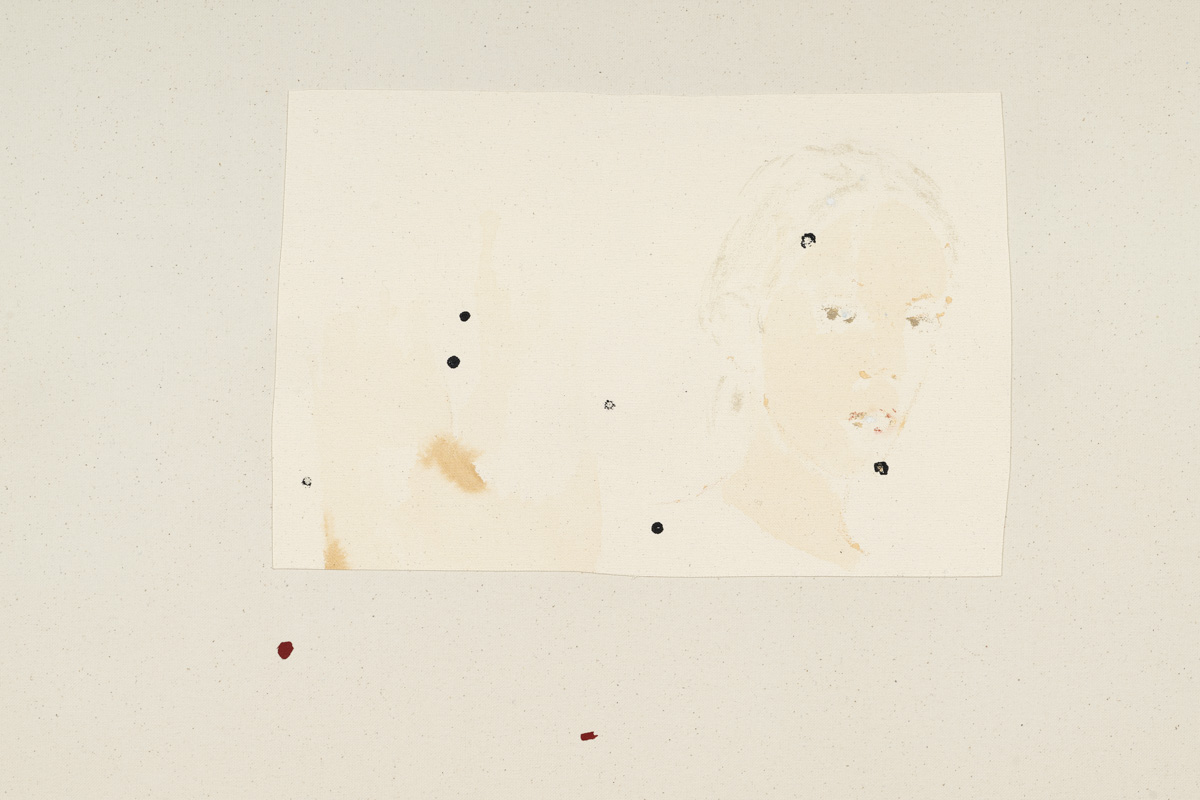
When Silva likes to proclaim that she works autobiographically, it accounts for the rawness of the material that she employs, as well as names a certain directness of manner. Biography finds its way into her work as sensual fragments; the loose threads of recollection, quite divorced from reality, certainly from narrative. What it amounts to is a form of abstraction; an extraordinary closeness, like that between our cognition and our memory, where it is impossible to tell where one ends and the other begins. In a previous work, it is an afternoon on the Venetian lido during childhood summed up in the pale orange hue associated with a particular ice cream. From among the new paintings, a hairband imprinted with the number 1943, the year of her father's birth and of the destruction of the Mantegna panels in Padua, her hometown. What is important, of course, is not whether the viewer knows any of this, whether such a hairband exists, or whether the woman in the picture is Silva herself, but that these details have piqued her interest, become attached to some aspect of her unconscious. What matters in psychoanalysis is also never "what happened", or even if it happened at all, but how it imprinted itself in the mind of the analysand. As a painter, Silva’s art consists in her ability to transfer this how – highly elusive and fragile – onto canvas, while maintaining its untamed relation to language; its thrilling, because highly unviable, openness.
Silva’s aversion to the vivid and the memorable means her paintings are destined to endure a special form of tough love. In the installation notes which accompanied the paintings to Cologne, Silva requested that the works be hung at several metres distance so as not to be allowed to form any relationship to one another. They are in a relationship only to the white wall, she insisted. To force the paintings to stand alone and to possibly let them perish there, as the analysand also drowns in the incoherence of their own language – there is a measure of brutality to such an approach. Analysis, we must remember, is not treatment but work, as painting, for Silva, too, is a serious and highly intellectual endeavour.
But this harsh pedagogy is also a way of insisting on the specificity of what each painting gives expression to. For outside of this one rule, Silva would have no other say in the hanging of the exhibition, a marked abdication of agency in an otherwise personal and carefully determined body of work. She knows that it is in the space between closeness and distance, vulnerability and control, the Private Index and the public encounter that the truth that lies beyond “what happened” might become visible to us at all.
Silva’s work evokes the figure of the young girl as a site where individual and collective fantasy can convene. Tiny, minutely painted roses, powder-coloured tulips, scraps of mother of pearl, a white embroidered ribbon, a page of handwriting reminiscent of a schoolgirl’s diary – here is the écriture feminine of the intimate and confessional made nearly universal by its dainty style and girlish register. To Freud, the notion of development, or maturation, meant a process of loss and diminishment, even failure. He saw the innocence of children as a form of truth from which we are doomed to become only ever more estranged in adulthood. And so we might see in Silva's evocations of girlishness an attempt to maintain a hold on that original and strangely impersonal truth of childhood, which, as Freud described it, “informs everything, and yet predicts nothing.” As the artist wrote to me during the production of the works, “Although these works are self-portraits of a thirty-five-year-old woman, I was interested in playing with the idea of a suspended or interrupted age – something that continually reactivates adolescence, like an underground river that resurfaces again and again throughout life.”
This feminine element has another, even more ambivalent, feature. In its very fragility, it makes an outline for violence; in its passivity, an invitation to transgression. There is a certain power in this archetypal feminine weakness. As the film-maker Catherine Breillat has observed, "weakness is stronger than strength because it leaves room for thought." And so crackling on the surface of these works – the very source of their tension – is their wideopenness held in check by Silva’s analytical framework; a mode of thinking fine enough to not impose form upon the natural abstraction of consciousness.
Kristian Vistrup Madsen
- Through
- 16 August 2026
- Venue
- Braunsfelder
- Address
- Geisselstrasse 84 - 86
50823 Cologne
- Hours
- by appointment